
Recruitment Fraud in the UAE: How Employer and Candidate Verification Protects Your Hiring in 2026
The UAE's Ministry of Human Resources and Emiratisation (MOHRE) has repeatedly had to warn jobseekers about fake job offers and recruitment scams in 2026 — a sign of how much fraud still moves through the region's hiring channels.
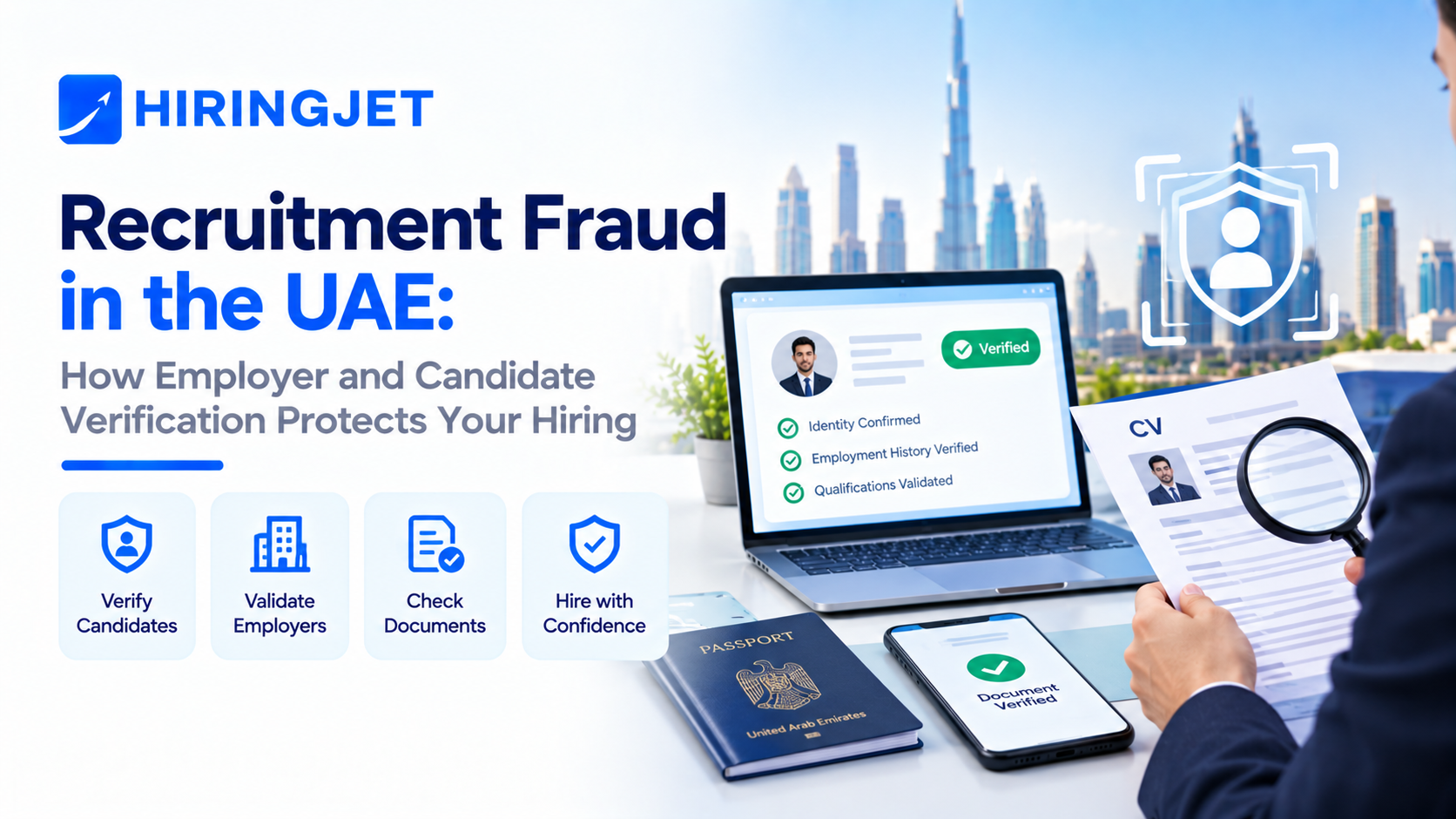
What gets discussed far less is the other side of the same problem: employers are exposed to it too, in the form of resume fraud, unverifiable credentials, and candidates who turn out not to be who they claimed during the interview. Both problems have the same root cause — a hiring channel where identity and documentation aren't consistently checked — and the same fix: verification, applied on both sides of the transaction. This guide looks at what the data actually shows about recruitment fraud in the UAE, why verification is a genuine business risk issue rather than a compliance formality, and how a platform's verification layer is meant to reduce that exposure for employers.
The Two Sides of Recruitment Fraud in the UAE
Jobseekers Are Being Targeted by Fake Employers
According to MOHRE guidance reported by Gulf News, scammers typically impersonate real, recognisable company names and branding, post unsolicited "too good to be true" offers on social media and messaging apps, and then ask applicants to pay for visa processing, medical examinations, or registration before any real recruitment process has taken place. The same reporting lists requests for passport copies, Emirates ID details, banking information, and one-time verification codes as common tactics used to harvest personal data alongside the money.
MOHRE's stated countermeasure is verification at the offer stage: legitimate UAE job offers are expected to carry a serial number or barcode that jobseekers can check via the MOHRE smart app, the MOHRE website, or its call centre (600590000) before sharing any sensitive information or engaging further. Separate reporting from Emirates 24|7 on individual scam cases illustrates the financial damage when that verification step is skipped — in one case a jobseeker expecting a AED 2,000 deduction had AED 6,000 withdrawn in a single transaction, and in another, a victim lost AED 20,000. These are individual, illustrative cases rather than an aggregate national statistic, but they show the fraud is not hypothetical.
Employers Are Exposed to Candidate-Side Fraud Too
The employer side of the problem is better quantified globally, even if UAE-specific numbers aren't published. HireRight's 2025 Global Benchmark Report, based on responses from more than 1,000 HR, risk, and talent-acquisition professionals worldwide, found that over 75% of employers caught at least one candidate discrepancy during background screening. A separate 2026 survey of 1,500 employers by iprospectcheck found that 54.1% of employers report background checks turning up discrepancies "very often" or "somewhat often," that 40.3% have withdrawn a job offer specifically because of resume fraud or unverifiable credentials, and that 30.2% only discovered the fraud after the candidate had already been hired. The same survey found real gaps in how consistently employers actually check: only 39.0% verify previous employment for every hire, and only 35.2% verify education credentials every time — which suggests the discrepancy rate would likely be even higher under full verification.
Read together, these numbers point to the same conclusion from both directions: neither jobseekers nor employers in a hiring channel with weak verification can fully trust who's on the other side of a job posting or an application — one more reason the choice between a recruitment agency, a job board, or an AI-screening platform increasingly comes down to how much verification each option actually does on your behalf.
Why Verification Is a Business Risk, Not Just a Compliance Box to Tick
For employers, the cost of skipping verification isn't abstract. A candidate hired on the strength of unverifiable credentials — as happened to 30.2% of employers in the iprospectcheck survey, only after the hire was already made — feeds directly into the same cost-per-hire benchmarks employers already track: wasted onboarding time, disrupted teams, and the cost of rehiring for the same role. There's a reputational dimension too. When scammers impersonate a real company's brand to post fake job offers — the exact pattern MOHRE has been warning about — it's the impersonated employer's name that takes the reputational hit with jobseekers, even though the company had nothing to do with the scam. And every unverified, low-quality, or fraudulent listing on a job platform erodes trust in that platform generally, making it harder for legitimate employers on the same channel to attract quality applicants. Verification, in other words, protects the employer's hiring outcomes and their brand at the same time.
How HiringJet's Verification Layer Works
HiringJet is built around verification on both sides of the platform, not just one. Employers register with a corporate email only — free and public email domains aren't accepted — and must upload their trade licence and tax registration documents as part of onboarding. Those documents are reviewed by HiringJet's Backoffice team before paid features unlock, and approved employers carry a Verified Employer badge visible to jobseekers browsing their listings. Job seekers go through their own verification steps too, including OTP-verified registration, and can carry a candidate verification badge on their profile.
Job postings themselves don't go live unchecked. Every new job post gets a 30-minute self-edit window, then passes through an AI review layer that either auto-approves it (making it live), flags specific fields for the employer to correct, or escalates it for manual Backoffice review. Two AI rejections on the same posting automatically trigger manual review rather than letting a listing get stuck in a rejection loop. Every profile, job, and subscription change is also captured in an audit log — the kind of paper trail that matters if a dispute over a listing or a hire ever needs to be traced back.
None of this eliminates fraud risk entirely — no platform can promise that — but it meaningfully narrows the gap that both fake employer listings and unverifiable candidate profiles rely on to go unnoticed.
What Employers Can Do Beyond the Platform to Reduce Hiring Fraud Risk
Platform-level verification is one layer; employer-side process is the other, and the iprospectcheck data above shows plenty of employers still have gaps to close:
- Verify employment history and education credentials for every hire, not just senior ones. With only 39.0% of employers verifying previous employment consistently and 35.2% verifying education consistently, per iprospectcheck's 2026 findings, inconsistent checking is itself part of why discrepancies keep surfacing after the offer stage.
- Don't rely on the interview alone to confirm identity and background. A structured reference-check step, even a brief one, catches a meaningful share of the misrepresentations that a resume and interview alone won't surface.
- Treat criminal history omissions as a distinct, higher-priority check. iprospectcheck's data flags criminal history omissions as both the most common serious discrepancy category and the one most likely to end a candidacy — worth a dedicated verification step rather than folding it into general reference checks.
- Use a platform with employer-side verification of its own. A candidate screening process is only as trustworthy as the pool of applicants it's drawing from, which is where platform-level candidate verification does work your internal process can't easily replicate at scale — see our broader AI recruitment guide for how automated screening and verification fit together.
Protecting Your Employer Brand from Impersonation Scams
Because MOHRE's own guidance confirms that scammers routinely copy real UAE company names and branding to run fake job offers, employer brand protection has become part of the recruitment-fraud conversation too. A few practical steps help: post jobs only through verified employer accounts on platforms that display that verification publicly, direct candidates in your own job postings to verify the offer independently if they're ever uncertain, and monitor occasionally for your company name being used in job postings you didn't create. A visible Verified Employer badge does double duty here — it reassures genuine applicants the listing is real, and it gives your company a documented, checkable identity on the platform that's harder for a scammer to convincingly imitate.
Hire on a Verified Platform: How HiringJet Helps
If your hiring process is exposed on either side of this problem — candidates you can't fully verify, or a brand that's vulnerable to impersonation — HiringJet's employer tools are built to close both gaps at once. Post a job through a verified employer account, screen applicants with Jet Screen's AI-ranked candidate search, and browse our directory of verified companies already hiring on the platform. Our employer FAQs cover the verification and onboarding process in more detail if you're setting up an account for the first time.
Frequently Asked Questions
What is recruitment fraud and how common is it in the UAE?
Recruitment fraud in the UAE runs in both directions: scammers impersonating real employers to defraud jobseekers, and candidates submitting unverifiable or fraudulent credentials to employers. MOHRE has issued repeated public warnings about the first in 2026, and while UAE-specific statistics on the second aren't published, global data — including a 2025 HireRight benchmark finding over 75% of employers caught at least one candidate discrepancy — suggests it's a persistent issue everywhere hiring happens online.
How does MOHRE help verify job offers in the UAE?
MOHRE requires legitimate job offers to carry a unique serial number or barcode, which jobseekers can check through the MOHRE smart app, the MOHRE website, or its call centre at 600590000 before sharing personal information or engaging further with a recruiter.
How many employers actually catch resume fraud during hiring?
According to a 2026 survey of 1,500 employers by iprospectcheck, 54.1% report that background checks reveal discrepancies "very often" or "somewhat often," and 40.3% have withdrawn a job offer specifically due to resume fraud or unverifiable credentials.
What does a "Verified Employer" badge mean on a recruitment platform?
On HiringJet, it means the employer's trade licence and tax registration documents have been reviewed and approved by the Backoffice team before the account could access paid features — giving jobseekers a documented signal that the company is real and registered, not a fabricated listing.
How can employers protect their brand from fake job posting scams?
Post exclusively through verified employer accounts, make sure your listings display employer verification publicly, and periodically check that your company name isn't being used in job postings you didn't create — a common tactic in the impersonation scams MOHRE has warned jobseekers about.
Does document verification slow down employer onboarding on HiringJet?
Employers get dashboard access immediately on registration, while the Backoffice team reviews uploaded documents in parallel — so verification runs alongside setup rather than blocking it outright, though paid features and the Verified Employer badge activate once that review is complete.