
Jet Screen: How AI-Powered Candidate Screening Helps UAE Employers Hire Faster
Every recruiter in the UAE knows the bottleneck isn't finding candidates — it's getting through them fast enough. A single Dubai job posting can pull in hundreds of applications within days, and manually reading every CV to find the handful worth a call is where good hires quietly slip away to faster-moving competitors. Industry-wide, AI-assisted screening has been shown to cut initial CV review time by as much as 71%, and organizations using AI across the hiring funnel report time-to-hire dropping from roughly 42 days to 28 days on average. Jet Screen is HiringJet's answer to that specific problem for UAE and GCC employers: an AI-driven candidate search and ranking engine built into your employer dashboard, purpose-built around the realities of hiring in this market — visa status, GCC experience, and a genuinely multinational candidate pool.
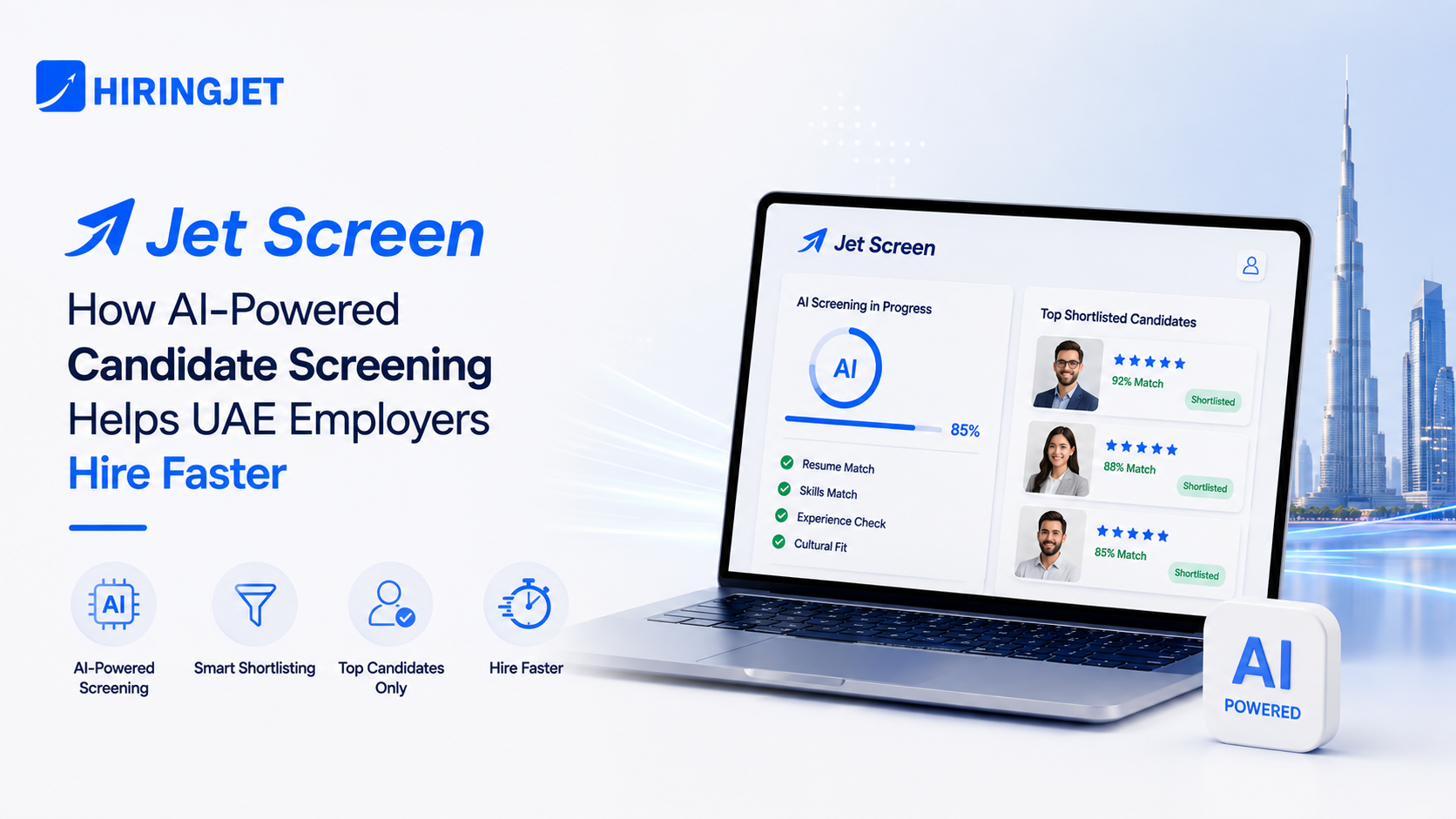
This guide breaks down exactly how Jet Screen scores and ranks candidates, where it sits in your day-to-day hiring workflow alongside HiringJet's other AI tools, why the underlying scoring model was built with UAE-specific hiring factors in mind, and how to get your first ranked shortlist running today.
The Real Cost of Manual Candidate Screening in the UAE
Every hour a recruiter spends manually sorting CVs is an hour not spent talking to the right candidate — and in a competitive market like Dubai, slow processes cost you the best people, not just time. Manual screening is also inherently inconsistent: two recruiters reviewing the same stack of CVs rarely shortlist an identical set, which introduces avoidable variability into who even gets a first conversation. This directly compounds cost-per-hire, since every extra day in the funnel is additional recruiter time, job-ad spend, and lost productivity from an unfilled seat — a topic we cover in more depth in our cost-per-hire benchmarks guide.
There's also a candidate-experience cost that's easy to underestimate. Strong candidates in the UAE are typically weighing more than one opportunity at a time, and a slow or silent screening process is one of the most common reasons a good applicant accepts elsewhere before you've even finished your first review pass. Speeding up the screening step isn't just an internal efficiency gain — it directly protects your offer-acceptance rate on the candidates you actually want.
What Jet Screen Actually Does?
The Match Percentile Score Explained
Instead of a flat keyword match, Jet Screen scores every candidate against a specific job with a weighted Match Percentile: Skills (30%), Experience (20%), Location (15%), Education (10%), Salary expectations (10%), Visa / Work Authorization (5%), Profile Freshness (5%), and Notice Period (5%). That weighting is deliberate. Skills and experience carry the most weight because they're the strongest predictors of on-the-job fit, while visa/work authorization is scored explicitly — not buried in a CV attachment — because it's one of the most common reasons a promising UAE hire stalls out late in the process. Profile freshness and notice period are factored in too, so you're not spending time on a 90%-skills-match candidate who last logged in eight months ago or can't start for a quarter.
Boolean Search, Filters & Saved Talent Pools
Beyond the ranked score, Jet Screen supports Boolean search and more than 30 filters, so you can search precisely — by skill combination, GCC experience, industry background, visa status, and more — rather than scrolling a generic results feed. Searches can be saved and re-run as new candidates register, and you can build candidate folders or talent pools ahead of an actual opening, so the next time you need to hire for a similar role, you're not starting from zero.
How Jet Screen Fits Into Your Hiring Workflow?
Jet Screen isn't a standalone tool bolted onto your process — it's built into the same workflow as the rest of HiringJet's employer features. You post a job (using the AI Job Description Generator if you want a first draft written for you), candidates apply with resumes parsed automatically via AI Resume Parsing so their profile data is structured and searchable from the moment they apply, and Jet Screen then ranks every applicant — plus any matching candidate already in the database — against your job's requirements. From there, you shortlist directly into HiringJet's Applicant Tracking System, moving candidates through New → Reviewed → Shortlisted → Rejected/Hired without re-entering data anywhere. Two visual signals help you read results faster: a Verified Badge on candidates who've completed identity/document verification, and a "Boosted" or Featured Candidate badge on profiles using Jet Boost — worth knowing so you understand why a candidate is surfacing prominently, separate from their Match Percentile score.
Why This Matters for UAE & GCC Employers Specifically?
Hiring in the UAE carries a layer of complexity most global ATS platforms weren't built for. Visa and work-authorization status genuinely determines whether a candidate can start on your timeline, so scoring it directly — rather than leaving it to a follow-up question three interviews in — removes a common late-stage dealbreaker. The UAE's labour market is also unusually multinational, and a scoring model that weighs skills, location, and experience together helps surface strong candidates across a diverse applicant pool rather than defaulting to whoever's CV happens to use the right keywords. And in a fast-moving market like Dubai, speed itself is a competitive advantage: the industry-wide data on AI screening cutting time-to-hire by roughly a third is a useful directional benchmark for what's possible when manual review stops being the bottleneck in your funnel.
Jet Screen vs. Screening Manually: What Actually Changes
It's easiest to see the difference in practice. Screening manually, a recruiter typically opens each application individually, reads the CV, cross-checks the job requirements from memory, and makes a subjective shortlist call — repeated hundreds of times per role, with no consistent scoring between candidates and no easy way to resurface a strong applicant who wasn't hired the first time. With Jet Screen, every candidate — new applicants and existing profiles in the database — is scored against the same weighted criteria the moment they match a role, ranked by Match Percentile, and searchable later through saved filters. The judgment call doesn't disappear; it just moves later in the process, to the shortlist stage where a recruiter's time is best spent, rather than the initial sort.
Getting Started with Jet Screen
HiringJet's free plan lets you post up to 3 jobs over 3 months, which is enough to test the platform, but candidate search and CV downloads through Jet Screen are part of the paid employer subscription tiers. To get started: post a role (or use an existing live posting), open Jet Screen from your employer dashboard, apply the filters relevant to your role, and review candidates ranked by Match Percentile. If you're hiring for a short-term or high-volume need, it's also worth pairing Jet Screen with Jet Walk-In hiring events for in-person hiring days, or Jet Remote if you're building a distributed team. And if your current process still runs through spreadsheets or a generic ATS, our guide on choosing an applicant tracking system walks through what to look for before you switch.
Jet Screen tends to pay off fastest for employers hiring at volume — retail, hospitality, sales, and customer service roles with high applicant counts — but the same scoring engine is equally useful for a single hard-to-fill specialist role, where the value isn't speed through volume but confidence that you haven't missed a strong match buried on page four of applicants. Either way, the setup cost is the same: a clear, specific job description, since Jet Screen's ranking is only as precise as the requirements you give it to score against.
Frequently Asked Questions
What is Jet Screen and how does it rank candidates?
Jet Screen is HiringJet's AI-powered candidate search and ranking engine. It scores every candidate against a specific job using a weighted Match Percentile — Skills 30%, Experience 20%, Location 15%, Education 10%, Salary 10%, Visa/Work Authorization 5%, Profile Freshness 5%, Notice Period 5% — so employers can shortlist based on a consistent, holistic score rather than manually reading every CV.
Do I need a paid HiringJet plan to use Jet Screen?
HiringJet's free plan covers posting up to 3 jobs over 3 months, but candidate search and CV downloads through Jet Screen are included in the paid employer subscription tiers.
How does Jet Screen handle UAE visa and work authorization requirements?
Visa and work authorization status is scored directly as part of the Match Percentile (5% weighting), so employers can see this factor up front rather than discovering it late in the interview process — a common cause of stalled UAE hires.
Can I save searches and build a talent pool with Jet Screen?
Yes. Jet Screen supports Boolean search, 30+ filters, saved searches, and candidate folders/talent pools, so you can build a pipeline of strong candidates ahead of an actual opening rather than starting from scratch each time you hire.
What's the difference between Jet Screen and a regular ATS?
A traditional ATS mainly tracks applicants through a pipeline. Jet Screen sits earlier in the process — it actively searches and ranks candidates (both applicants and the wider database) using AI scoring before they enter your shortlist, then hands off directly into HiringJet's built-in ATS for tracking.
How is a candidate's Match Percentile calculated?
It's a weighted score combining Skills (30%), Experience (20%), Location (15%), Education (10%), Salary expectations (10%), Visa/Work Authorization (5%), Profile Freshness (5%), and Notice Period (5%), giving a single, comparable score across all candidates for a given role.
Want to see Jet Screen against your own open roles? Post a job free on HiringJet, open Jet Screen from your employer dashboard, and see your first ranked shortlist in minutes.