
Jet Remote: How UAE Employers Can Hire and Manage High-Performing Remote Teams
Nearly 90% of UAE professionals say they now prefer hybrid or fully remote working arrangements, according to a Cisco survey of 1,050 full-time workers reported by Zawya — yet GulfTalent's regional research puts actual current remote/hybrid adoption across the GCC at only around one in five professionals. That gap between what employees want and what most companies are actually set up to offer is exactly where UAE employers who move first gain an edge in attracting talent.
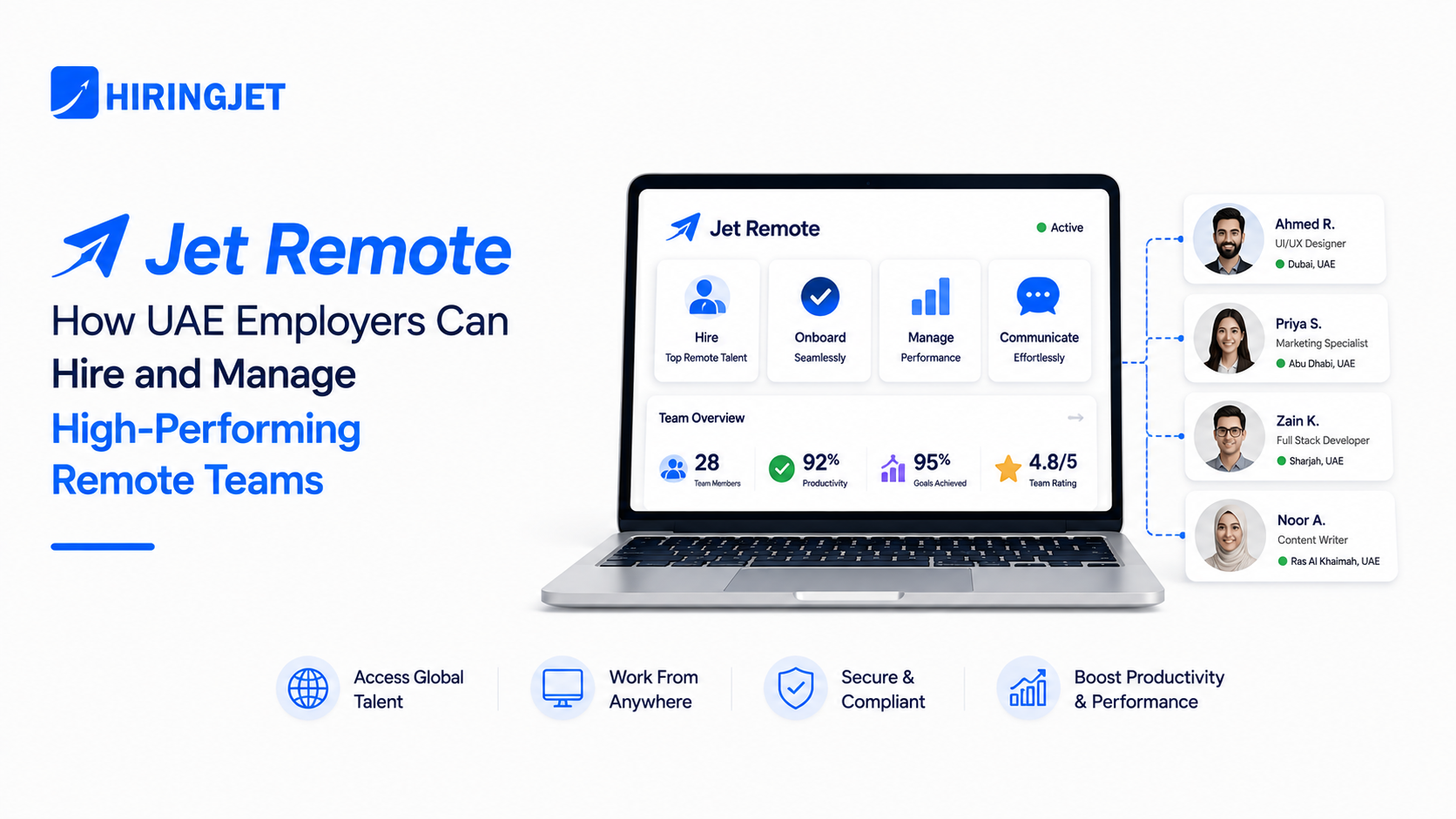
The problem most employers run into isn't whether to allow remote work — it's how to hire for it responsibly. A generic "remote OK" tag on a job post tells you nothing about whether a candidate's internet and power setup can support client calls, whether their time zone genuinely overlaps with your working hours, or whether they've ever actually worked remotely before. Jet Remote, HiringJet's structured remote-hiring feature, is built to close exactly that gap. Here's what it is, how it works, and how to start using it.
Why Remote Hiring Is Becoming Non-Negotiable for UAE Employers
The case for taking remote hiring seriously in the UAE isn't theoretical anymore — it's showing up directly in retention and recruitment data. In the Cisco-commissioned survey covering UAE professionals, 61% said they would be less likely to look for another job if their current employer offered flexible working options, and 83% said their companies already support some form of hybrid working scheme. But there's a readiness gap hiding behind that number: only 28% of respondents considered their organization "fully prepared" for hybrid work, with another 43% calling themselves merely "prepared."
GulfTalent's broader GCC research (surveying roughly 4,000 professionals and 1,000 managers) tells a similar story from the supply side: the UAE leads the region as the most remote-friendly market, and of the companies already running hybrid arrangements, a third plan to expand them further. On the demand side, GulfTalent found that 70% of office-based employees would switch jobs for a remote-work option with no pay reduction, and a further 9% would accept one even with a pay cut. For UAE employers competing for the same shrinking pool of skilled candidates — especially in IT, advertising, and other functions GulfTalent flagged as the highest remote-adoption sectors — offering a credible, well-managed remote or hybrid option is no longer a perk. It's a filter candidates are actively applying to shortlist employers.
What Is Jet Remote?
Jet Remote is HiringJet's dedicated remote-work module for both job seekers and employers. On the candidate side, it asks job seekers to complete a structured remote-readiness profile covering four areas: Location & Working Time (including time zone), Work Availability, Remote Work Setup (internet reliability, power backup, dedicated workspace), and an Introduction & ID Proof step for basic identity verification. Once completed, that candidate becomes visible and filterable inside employer remote-candidate searches — turning a vague "open to remote" checkbox into a structured, comparable data set.
On the employer side, Jet Remote lets you filter candidates specifically by time-zone overlap with your team, internet and power backup reliability, prior remote-work experience, and notice period — and to manage shortlisted remote candidates through the same folders, talent pools, and bulk-email tools you'd use for any other hire. It's a paid feature, available to employers on HiringJet's subscription plans (the free plan covers up to three job posts over three months but doesn't include CV search, downloads, or Jet Remote access).
The distinction matters because "remote-friendly" and "remote-ready" are not the same thing. A candidate can genuinely want a remote role without having a workspace, connectivity, or schedule that actually supports one — and that mismatch is usually what causes remote hires to underperform or churn within the first few months, not a lack of skill. By capturing readiness signals as structured data rather than leaving them to a candidate's cover letter, Jet Remote gives employers something closer to a real risk assessment than a hope-based filter.
How Jet Remote Works for Employers
Using Jet Remote follows the same basic flow as any HiringJet hire, with remote-specific filtering layered in at the candidate-search stage.
Step 1 — Post a Remote-Ready Job
Create your job posting as usual, marking it remote or hybrid. HiringJet's AI job-description generator can draft the listing for you from a few input details, or you can upload an existing JD and let the platform parse it — either way, the posting goes through the standard AI approval workflow before going live.
Step 2 — Filter Remote Candidates by Real Readiness Signals
Instead of scanning generic remote-job applicants, open Jet Remote's candidate search and filter by time-zone overlap, declared internet/power reliability, remote-work experience, and availability. This is the core difference from a standard job-board search: you're filtering on operational readiness, not just a self-declared "remote" preference.
Step 3 — Shortlist, Bulk-Email, and Manage in Folders
Save promising remote candidates into folders or talent pools, send bulk emails to a shortlist at once, and keep a running pipeline of remote-ready talent even for roles you're not actively hiring for yet — useful if you expect to scale a remote or distributed team over the coming quarters.
Step 4 — Track and Hire Through the ATS
Once you've shortlisted, move candidates through HiringJet's built-in Applicant Tracking System the same way you would any other hire, with real-time status updates and dashboard visibility into your remote hiring funnel specifically.
Jet Remote vs. Manually Sourcing Remote Talent
Most employers sourcing remote talent today do it the manual way: post on a general job board, mark the role "remote," and then individually screen every applicant's time zone, setup, and experience through calls or messages — often after several rounds of back-and-forth just to confirm basic logistics. That approach doesn't scale past a handful of hires and tends to surface avoidable problems late, like discovering a promising candidate's time-zone overlap with your team is only two hours a day, after you've already invested in interviews.
Jet Remote moves those logistics questions to the front of the process instead of the back. Because candidates complete their remote-readiness profile once, upfront, employers can filter on time-zone overlap, connectivity, and experience before a single interview is scheduled — and candidates carry a Verified Badge once HiringJet has checked their identity documentation, adding a basic trust layer that a cold job-board application doesn't provide. The result is fewer wasted screening calls and a shortlist that's already been pre-qualified on the specific factors that make or break a remote hire.
There's also a pipeline advantage that's easy to underrate: because remote-readiness profiles persist on the platform rather than resetting with every job post, an employer building toward a distributed team over several quarters can start saving and organizing strong remote candidates into folders now, well before a specific role opens, instead of starting the search from zero each time a vacancy appears.
Who Should Use Jet Remote?
Jet Remote is built for two overlapping groups of UAE employers. The first is companies actively building out distributed or hybrid teams — startups and multinationals were flagged by GulfTalent's research as the segments leading remote adoption in the GCC, often because they're hiring for functions (IT, software development, digital marketing, advertising, and customer support) that GulfTalent's data shows have the highest remote-work adoption rates regionally. The second is employers who aren't fully remote but need to widen their candidate pool beyond commuting distance of a single office — for example, hiring specialized finance, marketing, or technical talent from across the UAE or wider GCC rather than limiting the search to candidates who can commute daily to one Dubai or Abu Dhabi location.
It's a weaker fit for roles that are inherently on-site — retail floor staff, hospitality operations, construction, and warehouse roles, all of which GulfTalent's research flagged among the lowest remote-adoption sectors for structural reasons. For those, HiringJet's Jet Walk-In feature for in-person hiring events is typically the better tool.
Remote Hiring Challenges in the UAE — and How Jet Remote Helps
The Cisco/Zawya data points to three specific gaps UAE employers are still working through on remote work: only 28% of respondents felt their organization was "fully prepared" for hybrid arrangements, 70% said employers still need to rethink culture and management style for genuinely inclusive hybrid work, and roughly two-thirds understood the cybersecurity risks specific to remote setups. None of these are hiring-tool problems exactly — they're organizational readiness problems — but a structured hiring process can reduce the risk on at least two of them.
On the culture and management side, Jet Remote's upfront readiness profile (including declared working hours and time-zone overlap) means managers know from day one what real-time overlap they'll actually have with a remote hire, rather than discovering scheduling friction after onboarding. On the trust and security side, HiringJet's employer document verification and candidate ID verification (reflected in the platform's Verified Badge) give hiring managers a basic layer of assurance before extending remote access to company systems — a meaningfully different starting point than an anonymous application through a general job board.
Getting Started with Jet Remote on HiringJet
If you're ready to build or expand a remote team, start by posting your first role on HiringJet — the free plan lets you post up to three jobs over three months to test the process. To unlock Jet Remote's candidate search filters, CV downloads, and bulk-email tools for remote candidate pools, you'll need one of HiringJet's paid employer subscription plans. Visit the Jet Remote page to see the feature in detail, or head to HiringJet for Employers to compare plans and get your account verified. If you're also running in-person hiring alongside remote roles, it's worth pairing Jet Remote with Jet Screen for AI-ranked candidate search on your on-site roles, or Jet Walk-In if you're planning a walk-in hiring event for store or branch-level positions.
Frequently Asked Questions (FAQ)
What is Jet Remote on HiringJet?
Jet Remote is HiringJet's dedicated feature for remote hiring. Candidates complete a structured remote-work-readiness profile (location and working hours, availability, home setup, and ID verification), and employers can then search and filter those candidates by time-zone overlap, connectivity, remote experience, and notice period.
How is Jet Remote different from just posting a normal remote job?
A standard remote job posting only tells you a candidate applied for a remote role — it doesn't tell you whether their time zone overlaps with your team, whether their internet and power setup is reliable, or whether they have remote-work experience. Jet Remote captures all of that upfront in a structured profile, so employers can filter on it before scheduling interviews.
Can I filter remote candidates by time zone in Jet Remote?
Yes. Jet Remote's employer search lets you filter remote candidates specifically by time-zone overlap with your working hours, along with internet/power backup reliability, prior remote-work experience, and availability.
Is Jet Remote available on HiringJet's free employer plan?
No. HiringJet's free plan covers up to three job posts over three months but does not include CV search, CV downloads, or Jet Remote's candidate filtering tools. Jet Remote is unlocked as part of HiringJet's paid employer subscription plans.
Which industries in the UAE hire the most remote employees?
According to GulfTalent's regional research, IT and advertising currently show the highest remote-work adoption in the GCC, while construction and manufacturing show the lowest, largely due to the on-site nature of the work. The UAE overall leads the GCC as the most remote-friendly market.
How do I get started with Jet Remote as an employer?
Create a HiringJet employer account and post your first job (free for up to three postings over three months). To access Jet Remote's candidate search, filtering, and bulk-communication tools for remote candidate pools, upgrade to one of HiringJet's paid subscription plans from the Employers page.