
How to Hire Fashion Professionals in Saudi Arabia: A 2026 Guide for Employers
Saudi Arabia's fashion and apparel sector has moved from a retail afterthought to one of Vision 2030's more visible growth stories — new design institutes, Saudi-born labels showing at international fashion weeks, mega-mall expansion across Riyadh and Jeddah, and a retail workforce that the Ministry of Human Resources and Social Development now watches closely for nationalization compliance.
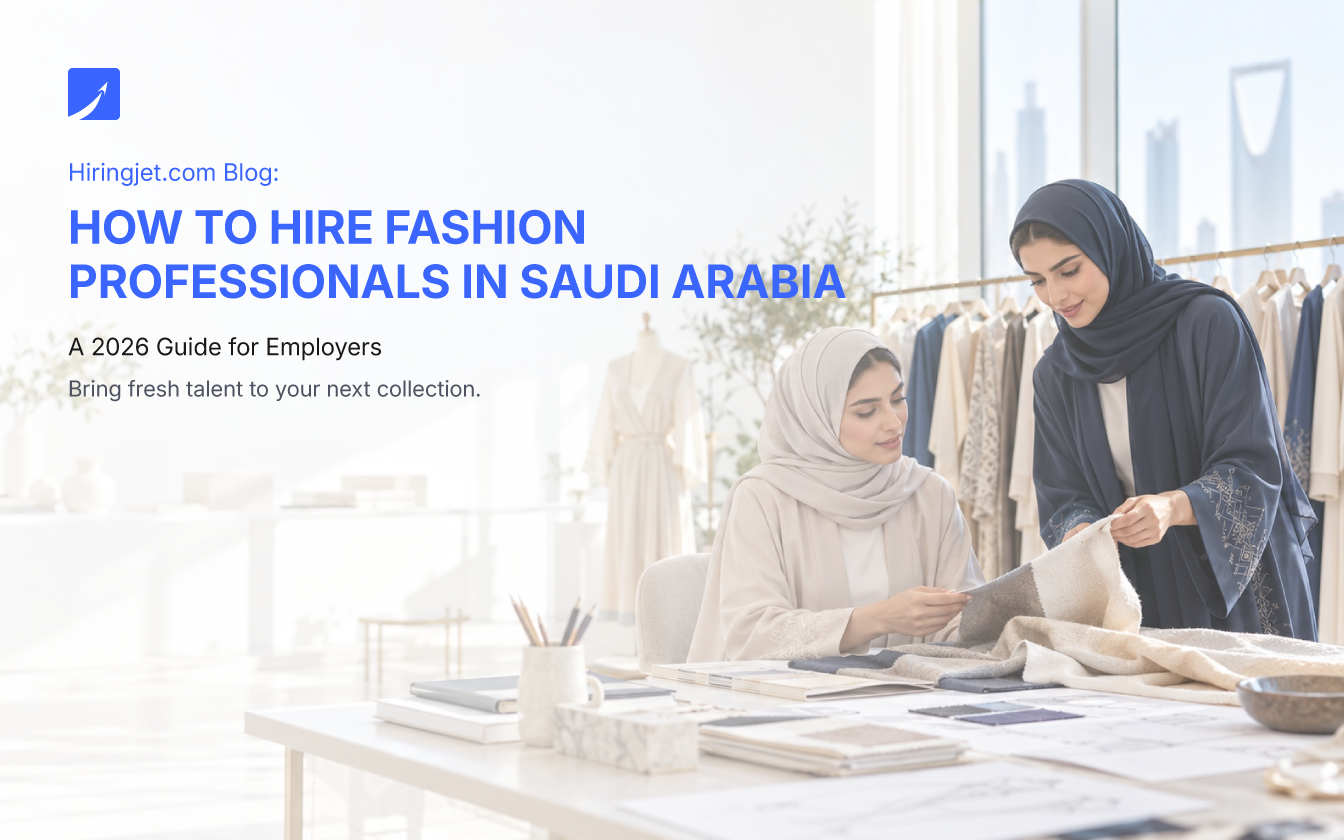
For employers trying to hire fashion talent — designers, merchandisers, store managers, e-commerce specialists, and sourcing leads — the opportunity is real, but so is the hiring friction. Saudization quotas are tightening again in 2026, the experienced retail-leadership pool is small relative to demand, and seasonal spikes around Ramadan and back-to-school create bulk-hiring pressure that a slow process can't absorb. This guide breaks down how to hire fashion professionals in Saudi Arabia in 2026 — who to hire, where to find them, what the latest Saudization rules require, and how to build a hiring process that doesn't stall at the worst possible moment.
Why Saudi Arabia's Fashion Industry Is a Growing Hiring Priority in 2026
The numbers behind the opportunity are substantial, even accounting for the fact that the most detailed figures available are drawn from 2022–2023 industry analysis rather than live 2026 data. Saudi retail fashion sales were projected to rise 48% to roughly $32 billion between 2021 and 2025 — an annualized growth rate of about 13% — with luxury retail growing even faster, at a projected 19%. As of 2022, the fashion industry employed an estimated 230,000 people, or about 1.8% of the domestic workforce, contributing roughly $12.5 billion, or 1.4% of GDP.
Saudi Arabia also imports more than $7 billion of fashion products annually, underlining how much of current demand is still served by international brands building out their Saudi retail and hiring footprint rather than wholly domestic supply. Sportswear and athleisure, a smaller but fast-growing segment, reached $1.4 billion in sales in 2022 and was projected to grow a further 21% by 2027.
Treat these as directional industry estimates rather than verified current-year statistics — publicly available, frequently updated figures specific to Saudi Arabia's fashion sector are limited — but the direction is unambiguous: this is a sector adding both retail footprint and specialized roles faster than most other categories of consumer retail in the Kingdom.
The Fashion Talent Employers Need to Hire in Saudi Arabia
Design, Merchandising & Buying
As more international and homegrown labels establish a genuine Saudi presence rather than treating the market as an export destination, demand is growing for merchandising planners, buyers who understand regional sizing and seasonal demand patterns, and designers who can adapt global collections for local market preferences (modest-wear lines, regional color and fabric preferences, Ramadan and Eid collection cycles).
Retail & Store Operations
Store managers, visual merchandisers, and floor sales staff remain the largest hiring category by headcount. This is also the category most directly affected by Saudization quotas, since front-line retail roles are explicitly targeted by nationalization policy in a way that specialized design or sourcing roles often aren't.
E-Commerce, Digital Marketing & Content
As Saudi consumers shift spending online, employers increasingly need e-commerce operations specialists, performance-marketing hires who can run paid social and search campaigns targeted at Saudi and GCC shoppers, and content producers for product photography and social commerce — a category of hiring that barely existed in this sector a decade ago and is now one of the fastest-growing.
Supply Chain, Sourcing & Quality
Behind the storefront, fashion retailers need sourcing specialists who understand regional import regulations and supplier relationships, quality-control staff, and logistics coordinators managing the lead times between global production and Saudi retail shelves — roles that are harder to fill locally and often draw on specialized expat experience.
Saudization and the New Hiring Rules Employers Must Know in 2026
Fashion and retail employers can't plan hiring in Saudi Arabia without tracking Saudization (Nitaqat) requirements, and those requirements moved again at the start of 2026. On January 19, 2026, the Ministry of Human Resources and Social Development (MHRSD) announced new decisions introducing a 60% Saudization requirement for targeted professions, with marketing roles subject to specific salary criteria under the new rules and a three-month grace period for employers to come into compliance.
Fashion retailers with significant marketing, merchandising, or sales headcount should assume this quota applies to at least part of their hiring plan and should confirm exact role coverage with MHRSD or a qualified Saudi employment advisor rather than assuming a prior year's quota still applies.
This builds on a longer-running policy direction: retail employment in Saudi Arabia has historically run around 20% Saudi nationals against a much larger expat-majority workforce, and Vision 2030's original retail-sector target called for a million new Saudi jobs in the sector. The direction of travel — rising nationalization quotas specifically targeting consumer-facing retail, sales, and marketing roles — is consistent and worth building into any multi-year Saudi hiring plan, not treating as a one-time compliance event.
Where to Find Qualified Fashion and Retail Candidates
Beyond standard job-board postings, fashion employers in Saudi Arabia typically draw from several channels at once: HiringJet's candidate search lets you filter and rank applicants by skill match rather than reviewing every CV manually, specialized GCC retail and fashion recruitment agencies maintain pipelines of experienced merchandising and store-management talent, local design and fashion institutes are an increasingly useful source for entry-level design and merchandising hires as Saudi Arabia invests in building a domestic creative-industry talent pipeline, and LinkedIn remains effective for senior buying, design-leadership, and e-commerce roles where candidates are less likely to be actively browsing job boards.
Building an Efficient Hiring Process for Fashion Roles
Screening at Scale with Jet Screen
Fashion retail hiring often means reviewing a high volume of applicants for store-level and seasonal roles alongside a much smaller number of specialized hires for design, buying, or sourcing. Jet Screen ranks candidates against your job requirements using a weighted match score across skills, experience, location, education, salary expectations, visa/work authorization, and notice period — letting your team focus review time on the candidates most likely to be a genuine fit rather than reading every application in submission order.
Seasonal and Bulk Hiring with Jet Walk-In
Ramadan, Eid, and back-to-school periods create short, intense staffing spikes for fashion retailers that a standard posting-and-interview cycle often can't absorb in time. Jet Walk-In lets employers publish and manage a structured walk-in hiring event — a minimum of ten open slots, running up to one calendar week — with AI-recommended candidates and automated job-description generation, so a retailer can fill 15–20 seasonal store roles in days rather than weeks.
Common Hiring Challenges in Saudi Arabia's Fashion Sector (and How to Solve Them)
The most immediate challenge is Saudization compliance risk: with the 60% quota for targeted professions taking effect in 2026 and a three-month grace period, employers who haven't audited their current workforce composition against the new requirement are exposed to compliance gaps that can affect their ability to sponsor further work visas. The second challenge is competition for a genuinely small pool of experienced design, merchandising, and retail-leadership talent — a problem best addressed by building an employer brand that resonates with both Saudi nationals building retail careers and the specialized expat talent the sector still depends on for design and sourcing roles.
Third, high turnover at the store-floor level inflates the real cost per hire far beyond the advertised salary once replacement recruiting, onboarding, and training time are factored in — a cycle that faster, better-targeted screening at the top of the funnel helps interrupt. Finally, many fashion retailers are still running hiring on manual spreadsheets and email threads; adopting a proper applicant tracking system is one of the highest-leverage, lowest-cost fixes available to a mid-sized retail employer in this market.
How HiringJet Helps Employers Hire Fashion Talent in Saudi Arabia
HiringJet gives fashion and retail employers in Saudi Arabia a single platform to post roles across store operations, design, e-commerce, and sourcing, screen applicants with Jet Screen's AI-ranked matching, and run seasonal bulk-hiring events with Jet Walk-In instead of coordinating interviews one at a time. Verified employer status and document-checked candidate profiles reduce the fraud and no-show risk that's especially costly during a short seasonal hiring window, and our employer dashboard tracks applications-per-role and time-to-shortlist so your team can see exactly where a hiring plan is slipping before it becomes a staffing gap on the shop floor.
Frequently Asked Questions
What is the Saudization requirement for fashion and retail hiring in 2026?
MHRSD announced on January 19, 2026 that targeted professions — including marketing roles subject to specific salary criteria — now carry a 60% Saudization requirement, with a three-month grace period for employer compliance. Fashion retailers with significant marketing, merchandising, or sales headcount should confirm exact coverage with MHRSD or a qualified local employment advisor, since the published rules don't name every covered job title.
Can international fashion brands still hire expat designers and specialists in Saudi Arabia?
Yes. Saudization quotas target specific professions and are heaviest in front-line retail, sales, and marketing roles rather than specialized design, sourcing, or technical positions, where expat hiring remains common. Employers should still track their overall workforce nationalization ratio under Nitaqat, since it affects visa sponsorship capacity across all role types.
How big is Saudi Arabia's fashion and apparel market?
Industry estimates from 2022–2023 projected Saudi retail fashion sales to reach roughly $32 billion by 2025, a 48% increase driven largely by luxury and athleisure growth, with the sector employing an estimated 230,000 people as of 2022. More recent, verified figures specific to 2026 were not available at the time of writing.
What's the fastest way to staff a seasonal retail hiring spike in Saudi Arabia?
A structured walk-in hiring event — such as HiringJet's Jet Walk-In — is typically faster than a standard posting-and-interview cycle for filling 15–20 store-level roles ahead of Ramadan, Eid, or back-to-school peaks, since it compresses sourcing, screening, and interviewing into a single scheduled event rather than running them sequentially over several weeks.
Do I need a trade license to hire for a fashion retail business in Saudi Arabia?
Employers need a valid commercial/trade registration and must register through the standard employer verification process before posting roles or sponsoring work visas. Document and license verification is part of the employer onboarding process on platforms like HiringJet, and non-compliant entities should expect delays in getting paid-plan features and CV access approved.
How does HiringJet help fashion employers screen candidates faster?
Jet Screen ranks every applicant against your job's requirements using a weighted match score covering skills, experience, location, education, salary, visa status, and notice period, so your hiring team reviews a short, ranked shortlist instead of every incoming application in the order it arrived.
Ready to build your Saudi fashion hiring pipeline? Post a job with HiringJet, explore live roles in Saudi Arabia and in Riyadh, and set up Jet Screen to start ranking candidates from day one.