
Executive Assistant Salary in Dubai, UAE (2026): What You Should Really Be Earning
If you work as an executive assistant in Dubai, or you are planning a move into the role, the honest answer to “what should I be earning” is that it depends far more on where you look than most job seekers expect. Three of the most-cited salary sources for the UAE market currently show executive assistant pay in Dubai ranging from roughly AED 5,500 a month on the low end to a median of about AED 13,000 a month — a gap wide enough to change how you approach your next negotiation entirely.
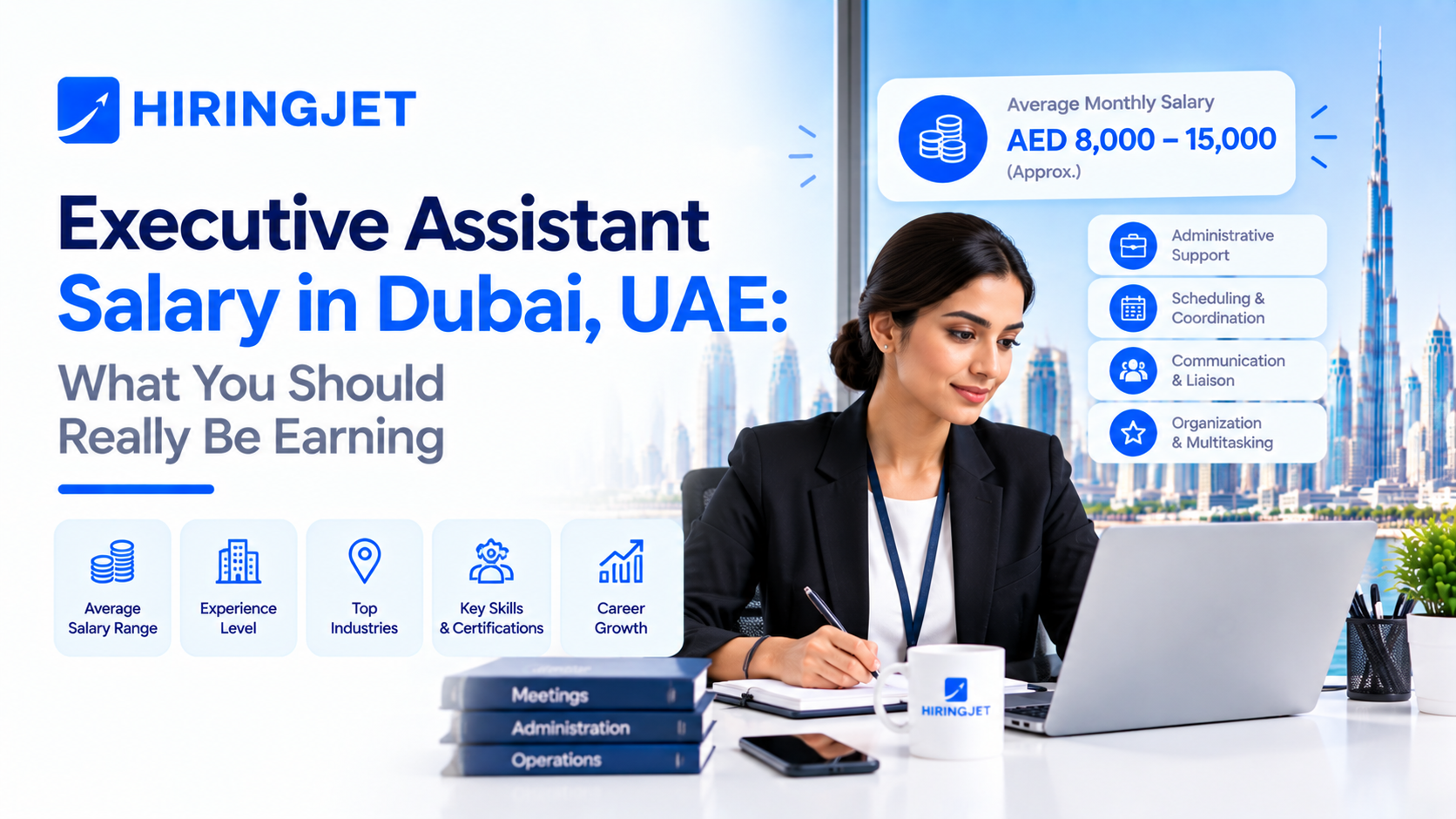
This guide walks through what the real 2026 data actually says, why the numbers diverge so much between sources, how experience and industry shift your earning potential, and what you can do — starting with your CV and your next negotiation — to land nearer the top of the range.
What Does an Executive Assistant Actually Do in the UAE?
An executive assistant (EA) in the UAE typically supports one or more senior leaders — a CEO, managing director, or board — with calendar and inbox management, travel and itinerary planning, board and leadership-meeting coordination, minute-taking, and confidential correspondence. In practice, the role in Dubai and Abu Dhabi often extends further than the job title suggests: many EAs also liaise with government departments for document attestation, visa renewals, and trade-licence paperwork, coordinate with PROs (public relations officers), and in family-owned businesses or private offices, occasionally handle personal or household logistics for the executive they support.
This is also where the role gets confused with, and sometimes underpaid relative to, a personal assistant or administrative assistant. A true executive assistant carries more decision-making authority, more confidentiality exposure, and often manages a small support team — which is exactly why the salary data below spans such a wide range.
Executive Assistant Salary in Dubai, UAE (2026): The Numbers
Three independent, currently live 2026 salary sources were checked for this guide. Each uses a different sample and methodology, and each lands on a meaningfully different number — which is exactly why you should treat any single salary site as a starting point, not a verdict.
Glassdoor: AED 7,000–18,000 a Month Base Pay (Dubai-Specific)
Glassdoor’s Dubai-specific data, drawn from 50 salary submissions, puts median total pay for an executive assistant at roughly AED 13,000 a month (about AED 156,000 a year), with base pay ranging from AED 7,000 to AED 18,000 a month and additional pay — bonuses, allowances, or commission — adding a further AED 396 to AED 2,000 a month on top.
GulfTalent: AED 9,000 a Month Average Across the UAE
GulfTalent’s UAE-wide salary database, built from 134 professionals across 125 companies in 11 industries and updated in September 2026, puts the average executive assistant salary at AED 9,000 a month, with a full observed range of AED 4,000 to AED 20,500. Notably, GulfTalent’s data shows Abu Dhabi paying slightly higher than Dubai for this role, with construction the highest-paying industry, followed by real estate and professional services.
Indeed: AED 5,535 a Month Average (Dubai, Skewed Toward Junior Roles)
Indeed’s Dubai-specific figure, based on 268 self-reported salaries updated as of 30 August 2026, comes in lowest of the three at an average of AED 5,535 a month, with a range of AED 2,282 to AED 13,423. This average sits well below both Glassdoor’s and GulfTalent’s figures for the same city.
Why the Numbers Are So Different
The gap between AED 5,535 and AED 13,000 a month is not a data error — it reflects who is reporting each number. Glassdoor’s smaller, 50-person Dubai sample skews toward more senior EAs at larger corporates who tend to self-report on the platform. Indeed’s much larger 268-person sample pulls in a wider mix of administrative-assistant-adjacent and junior titles, which drags its average down. GulfTalent’s 134-person, UAE-wide panel sits in between and captures cross-emirate variation that a Dubai-only figure misses.
Self-reported salary data always carries this kind of sampling bias, so the practical takeaway is to treat these as directional ranges rather than a guaranteed number. A realistic working band for a solidly experienced, Dubai-based executive assistant at a mid-to-large company is roughly AED 7,000–13,000 a month, with senior EAs supporting C-suite executives at large corporates, multinationals, or private family offices commanding AED 15,000–20,000 or more, consistent with the top end of GulfTalent’s and Glassdoor’s observed ranges.
Executive Assistant Salary by Experience Level in the UAE
Mapped against the ranges above, entry-level executive assistants and those transitioning from administrative or PA roles (roughly 0–2 years supporting senior leadership specifically) tend to land closer to the AED 5,000–8,000 a month band seen in Indeed’s and GulfTalent’s lower ranges. Mid-career EAs with 3–6 years of experience, particularly those who have supported department heads or regional directors, typically sit in the AED 8,000–13,000 range that Glassdoor’s median reflects. Senior executive assistants with 7 or more years of experience, especially those supporting a CEO, board, or managing director directly, are the ones pulling GulfTalent’s range up toward AED 18,000–20,500 a month.
Executive Assistant Salary by Industry and Employer Type
Industry matters more for this role than many job seekers assume. GulfTalent’s September 2026 data ranks construction as the highest-paying sector for executive assistants in the UAE, followed by real estate and professional services — all sectors where EAs are frequently trusted with high-value contract and stakeholder coordination. Government-adjacent entities and large multinationals also tend to pay toward the top of the range, often because they require bilingual Arabic/English skills or security clearance-level discretion. Smaller trading companies, SMEs, and retail-sector employers generally sit at the lower end of the observed ranges.
Skills That Increase Your Earning Potential as an Executive Assistant
A few specific, demonstrable skills consistently separate the AED 7,000-a-month executive assistant from the AED 15,000-plus one: advanced calendar and multi-stakeholder travel management, board-meeting minute-taking and follow-up tracking, bilingual Arabic/English communication, fluency with productivity and collaboration tools (Microsoft 365, Google Workspace, project trackers), a verifiable track record of discretion with confidential or commercially sensitive information, light project-management or PMO experience, and direct experience supporting a single C-suite executive or board rather than a shared pool of managers. UAE-specific administrative knowledge — visa renewals, document attestation, and trade-licence processes — is also a genuine differentiator that many EA job descriptions list as a requirement rather than a nice-to-have.
If you’re not sure how to translate these into a CV that actually gets shortlisted, start with how to write a CV for UAE jobs, which covers how UAE employers and screening tools scan for exactly this kind of evidence.
How Career Growth Typically Works for Executive Assistants in the UAE
The salary ranges above aren’t static bands you’re stuck in — they map fairly closely to a recognisable career path. Most executive assistants in the UAE start out in a general administrative assistant or receptionist-adjacent role (roughly AED 3,500–5,500 a month), move into a personal assistant or junior EA position supporting a single manager or department head (AED 5,500–8,000), then progress into a full executive assistant role supporting a director or VP-level executive, which is where Glassdoor’s and GulfTalent’s mid-range figures of AED 8,000–13,000 apply most directly.
From there, the path typically forks two ways. Some EAs move laterally into office-manager or executive-coordinator roles with broader operational responsibility, while others move up into senior executive assistant or chief-of-staff-adjacent positions supporting a CEO or board directly — the tier where GulfTalent’s AED 18,000–20,500 upper range and beyond becomes realistic. The single biggest accelerant between these stages, based on the skills correlated with higher pay in the data above, isn’t tenure alone — it’s taking on visible ownership of something beyond your job description, such as leading a small admin team, owning an internal process, or being the go-to person for a specific type of confidential or high-stakes coordination.
If you’re earlier in this path, it’s worth being deliberate about which employer you join next, since the range of exposure you get — supporting one manager versus a full leadership team, for example — often matters more for your next salary jump than the job title on your current offer letter.
How to Negotiate a Higher Executive Assistant Salary in Dubai
Walk into any offer or annual review with the specific band for your experience level and industry, not a vague sense that you “should earn more.” Use the Glassdoor, GulfTalent, and Indeed figures above as your anchor points, and be ready to explain which end of the range your experience justifies — years supporting C-suite versus department-head level, bilingual ability, or industry-specific exposure like construction or real estate all matter.
Negotiate the total package, not just the base number. In the UAE, that means clarifying the housing and transport allowance structure, the annual flight-ticket allowance, how end-of-service gratuity is calculated against your basic salary, and any mobile or communication allowance — these can shift your effective total compensation by 15–30% beyond the base figure alone. For a full walkthrough of how to structure this conversation, see how to negotiate a salary in the UAE.
How to Find the Right Executive Assistant Role in Dubai and the UAE
Once you know your target range, the fastest way to reach employers actually hiring at that level is to build a complete profile and apply directly rather than relying on a single job board. On HiringJet, you can search live executive assistant and admin roles across Dubai and the wider UAE, filter by job category to compare EA openings against related admin and PA roles, and set alerts so new postings from verified employers reach you first.
Before you apply, it’s worth reviewing how to prepare for a job interview in Dubai and making sure your LinkedIn profile is optimised for UAE recruiters, since many EA hires — especially at senior level — come through direct outreach rather than a job-board application alone. You can also browse all open roles in Dubai to see how executive assistant openings compare with other administrative and support roles currently live on the market.
Frequently Asked Questions
What is the average executive assistant salary in Dubai in 2026?
It depends on the source: Glassdoor’s 50-submission Dubai sample shows a median of about AED 13,000 a month, GulfTalent’s UAE-wide 134-person panel averages AED 9,000 a month, and Indeed’s larger 268-submission Dubai sample averages AED 5,535 a month. A realistic working range for an experienced Dubai-based EA at a mid-to-large company is AED 7,000–13,000 a month.
Do executive assistants in Abu Dhabi earn more than in Dubai?
According to GulfTalent’s September 2026 UAE-wide data, Abu Dhabi pays slightly higher than Dubai for this role on average, though both emirates fall within the same broad AED 4,000–20,500 range observed nationally.
What skills increase an executive assistant’s salary in the UAE?
Bilingual Arabic/English ability, board-level minute-taking, advanced multi-stakeholder calendar and travel management, demonstrated discretion with confidential information, light project-management experience, and direct experience supporting a single C-suite executive rather than a shared pool of managers all correlate with higher pay in the ranges reported by Glassdoor and GulfTalent.
Is an executive assistant salary in the UAE tax-free?
Yes. The UAE does not levy personal income tax on salaries, so the AED figures cited by Glassdoor, GulfTalent, and Indeed represent take-home pay before any employer deductions such as loan repayments, not after-tax figures.
What’s the difference between a personal assistant and an executive assistant in terms of pay?
A personal assistant role is generally narrower in scope — scheduling and correspondence for one manager — while an executive assistant typically carries more decision-making authority, board or leadership-team exposure, and sometimes manages a small support team. This broader remit is a large part of why EA salaries in the data above extend well above typical PA and admin-assistant pay.
How can I negotiate a higher executive assistant salary in Dubai?
Anchor your ask to the specific band for your experience level and industry using current data rather than a general sense of your worth, and negotiate the full package — housing and transport allowance, flight ticket, and gratuity basis — alongside the base salary, since these can add 15–30% to your effective total compensation.