
How to Ace a Job Interview in Dubai: A Complete Guide (2026)
We have been on both sides of thousands of job interviews in the UAE over 15 years. As recruiters preparing candidates before interviews. As hiring advisors debriefing employers afterward. And we have heard the same feedback from employers hundreds of times: the candidate seemed qualified on paper but did not perform well in the room.
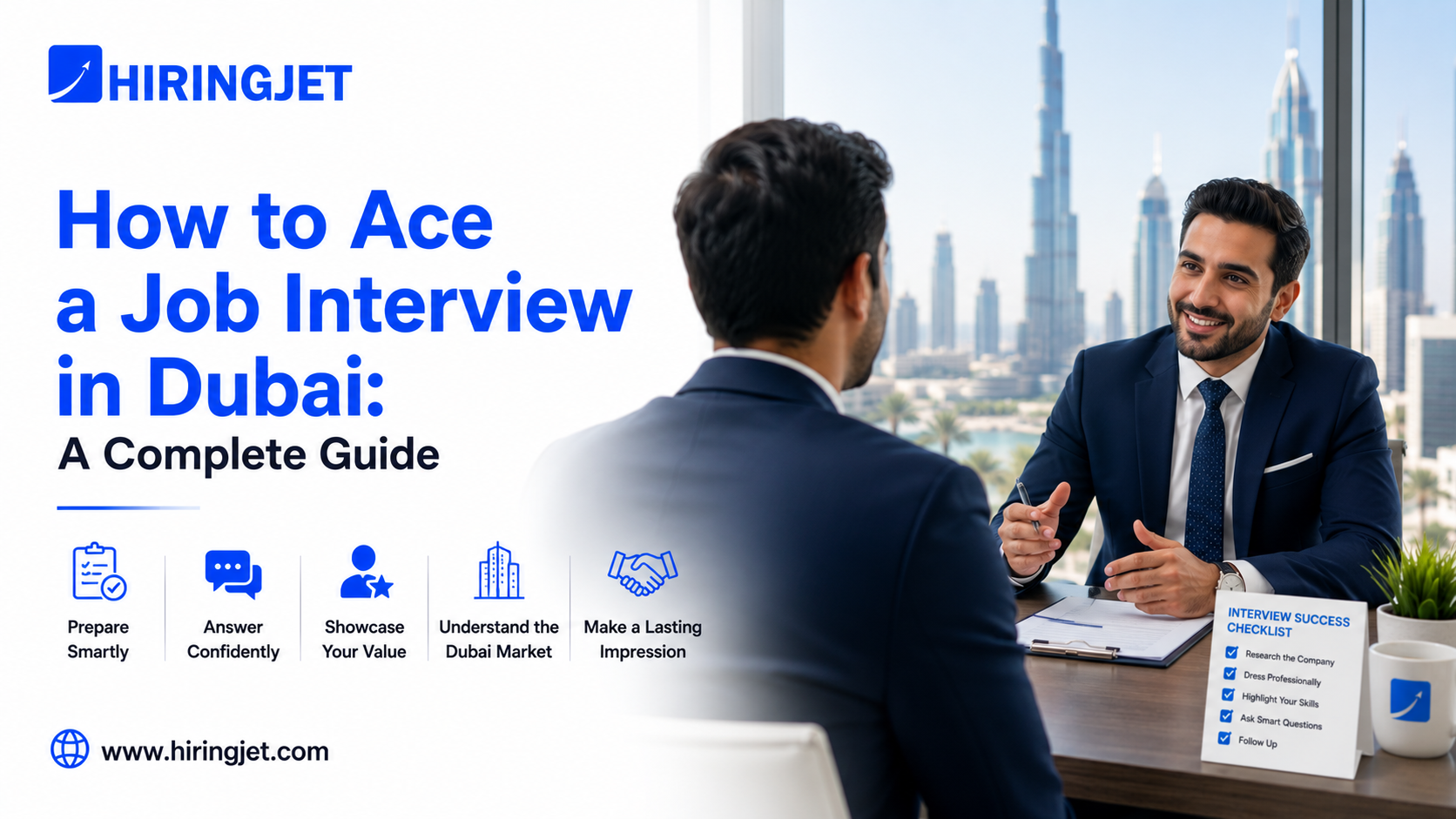
Most of the time, the gap is not competence. It is preparation. And more specifically, preparation calibrated to the UAE market rather than preparation based on generic interview advice that does not account for how Dubai interviews actually work. This guide gives you that calibration.
Understanding Dubai Interview Culture
Dubai is a multicultural business environment. Your interviewer may be Emirati, Indian, British, Lebanese, Egyptian, American, or any of a hundred other nationalities. Interview styles vary accordingly. Some interviewers are formal and structured. Others are conversational and relationship-focused.
What is consistent across almost all Dubai interviews is this: employers are evaluating whether they want to work with you, not just whether you can do the job. Technical competence is the baseline requirement. Professionalism, communication clarity, and cultural adaptability are the differentiators.
Before the Interview: Preparation That Makes a Difference
Research the Company Properly
Not just their website homepage. Read their recent LinkedIn posts, check their Google reviews, look at the profiles of people you will be meeting, and understand their product or service from the perspective of their customers. Employers in Dubai notice when a candidate has done genuine research. They notice even more when a candidate has not.
Know Your Own CV
This sounds obvious. It is not. A significant number of candidates in UAE interviews are caught off guard by questions about their own career history because their CV was written or heavily edited by someone else, or because they have not revisited it recently. Before every interview, read your CV top to bottom and be prepared to speak fluently about every role, every gap, and every transition.
Prepare for Salary Questions Before You Walk In
UAE interviews ask about salary expectations earlier than most other markets. The phone screen frequently opens with it. The first in-person interview often includes it. Be ready with a specific range based on market research. Saying you are open to discussion signals that you do not know your own market value. Saying a specific range signals confidence and market awareness.
Prepare Three Stories
Most UAE interviews will ask you to describe situations from your experience. Prepare three strong professional stories using the STAR structure: Situation, Task, Action, Result. Choose stories that demonstrate initiative, problem-solving, and measurable impact. Practise telling each one in under two minutes.
The Phone Screen: Your First Real Interview
Most UAE hiring processes begin with a 15 to 20 minute phone screen. Candidates frequently treat this as a formality. It is not. The phone screen determines whether you progress to the in-person or video interview stage.
- Be in a quiet location with strong signal. Background noise and poor audio quality communicate disorganisation.
- Have your CV in front of you. You will be asked about it.
- Know your notice period, visa status, and salary expectation before the call starts. These are the three most common opening questions.
- Listen carefully to what they tell you about the role and ask one or two specific questions. It signals genuine interest.
The In-Person or Video Interview: What UAE Employers Evaluate
First Impressions in Dubai
Dress conservatively and professionally for every first interview in Dubai regardless of the company's apparent culture. Business formal is always the safe choice. Arriving late, even by five minutes, is a significant negative signal in UAE business culture. Build in extra time for traffic, which in Dubai can be significant at any time of day.
The Most Common Interview Questions in the UAE
Prepare specific, concise answers for each of the following questions, which appear consistently across UAE employers and industries.
- Tell me about yourself: a two to three minute professional summary covering your career trajectory, key achievements, and why you are looking for a new role now.
- Why are you interested in this role and this company: a specific answer referencing something real about the company, not generic praise.
- What is your biggest professional achievement: a STAR-structured story with a quantified outcome.
- Why are you leaving your current role: honest, professional, and forward-looking. Never speak negatively about a previous employer in a UAE interview.
- Where do you see yourself in three to five years: a credible growth trajectory that aligns with what the role and company could realistically offer.
- What is your expected salary: a specific range with a brief rationale.
Questions You Should Ask the Interviewer
Asking specific, thoughtful questions signals preparation, genuine interest, and commercial intelligence. Prepare at least three questions in advance.
- What does success look like in this role at three months and at 12 months?
- What are the biggest challenges the team is currently facing that this hire is expected to address?
- How would you describe the management style and team culture?
- What does career progression typically look like for someone who performs well in this role?
Avoid questions about salary, leave, and benefits in the first interview unless the interviewer raises them. These questions at the wrong stage signal that your primary interest is in the package rather than the role.
Handling the Salary Conversation
When an interviewer asks your expected salary, give a researched, specific range delivered confidently. For example: 'Based on my research of the market for this level of role in this sector, and on my experience over the past seven years, I am looking for a basic salary in the range of AED 18,000 to AED 22,000.
This signals market awareness, anchors the conversation at a reasonable level, and opens a dialogue rather than closing it. The worst answers are either refusing to give a number, which frustrates most UAE interviewers, or giving a number with no rationale, which invites pushback with no foundation to stand on.
After the Interview: What Most Candidates Skip
Send a Follow-Up Message
Within 24 hours of any interview, send a brief, personalised message to the interviewer or the recruiter who arranged it. Thank them for their time, reference one specific point from the conversation, and confirm your continued interest in the role. This is standard professional practice in the UAE market and is not done often enough to go unnoticed when done well.
Reflect and Debrief
After every interview, write down the questions you were asked, your answers, and how you felt each one landed. Identify the one or two answers that were weaker than you would have liked and prepare stronger versions before the next interview. Interview performance improves with practice and deliberate reflection.
Common Interview Mistakes UAE Candidates Make
- Arriving unprepared for basic questions about their own CV or career history
- Speaking negatively about previous employers, which is a consistent red flag for UAE hiring managers
- Giving vague, generic answers that could apply to any candidate in any interview
- Not asking any questions, which signals passivity or lack of genuine interest
- Being unprepared for the salary question and either refusing to answer or giving a number with no rationale
- Not following up after the interview
- Overselling qualifications or experience in ways that create expectations the candidate cannot meet on the job
How HiringJet Supports UAE Job Seekers
Strong interview performance starts with a strong application. If your CV is not getting you to the interview stage, the preparation in this guide has no opportunity to work.
JetBoost CV on HiringJet diagnoses your CV for ATS compatibility, rewrites it for both machine and human readability, and adds a Verified Badge that signals credibility before the interview begins. And JetAlert SMS delivers fresh UAE job alerts directly to your mobile every week for AED 11, ensuring you are applying to live roles before they are buried in application volume.
Visit HiringJet.com to explore all our job seeker tools.
Frequently Asked Questions
What should I wear to a job interview in Dubai?
Business formal for all first interviews, regardless of the company's culture or dress code. For men this means a suit or at minimum smart trousers, a button shirt, and a jacket. For women this means professional business attire that is conservative in line with the UAE's cultural context. Overdressing for a first interview is not held against you. Underdressing is.
How early should I arrive for an interview in Dubai?
Aim to arrive at the building 10 to 15 minutes before your interview time. Factor in Dubai traffic, parking, and building access. Arriving late, even by five minutes, is a negative first impression that is difficult to overcome in a market where punctuality signals professionalism.
Is it acceptable to negotiate salary in a Dubai interview?
Yes, and it is expected. UAE employers factor negotiation into their initial offer. The key is negotiating based on market data and your specific experience, not on personal expectation alone. Know your range before the interview, state it confidently, and be prepared to explain your rationale.
How long does the hiring process typically take in Dubai?
For most mid-level roles in the UAE private sector, a typical hiring process from first interview to offer runs two to four weeks. The fastest processes move from first contact to offer in under two weeks. The slowest stretch to two months or more, at which point the strongest candidates have usually accepted other offers. If you are not hearing from an employer within five to seven business days of a final interview, it is entirely appropriate to follow up.
The HiringJet Team
Built by recruiters and business development professionals who have lived every side of the UAE job market.
Published: 16th July, 2026 | Category: CV and Interview Advice | Author: The HiringJet Team