
Skills-Based Hiring: How to Actually Build a Skills-First Recruitment Process in 2026
Skills-based hiring has a rhetoric problem. Roughly two-thirds to 85% of employers now claim to practice it, depending on which 2026 survey you read, and a majority say they have dropped degree requirements from at least some roles. But independent research from the Burning Glass Institute and Harvard Business School tells a more complicated story: of employers who publicly dropped degree requirements, only about a third actually changed who they hired. Nearly half made the policy change on paper and kept hiring the same way in practice.
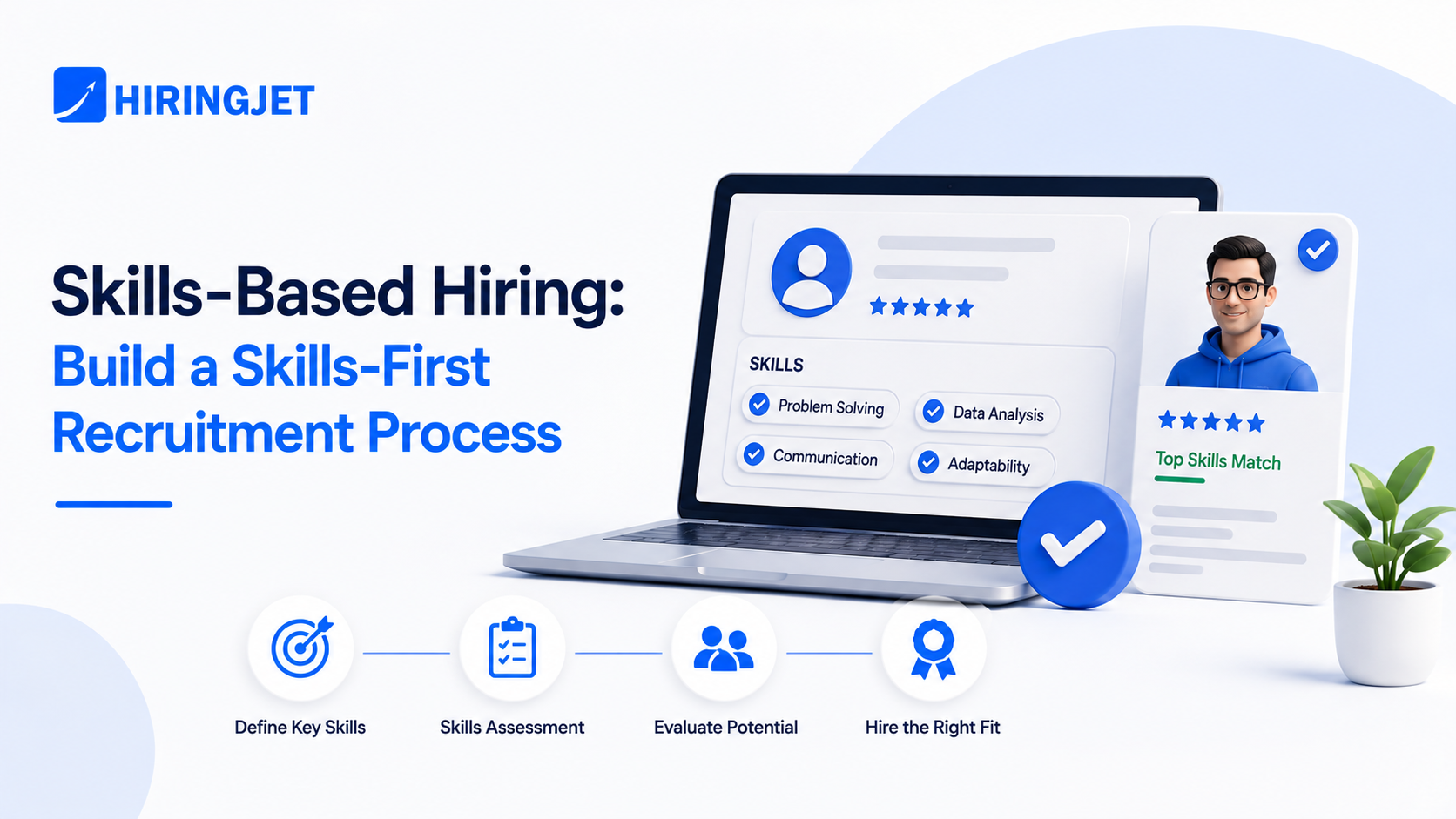
That gap between stated policy and actual hiring behavior is the real story in skills-based hiring right now, and it is where most 2026 content stops short. This guide skips the adoption statistics roundup and goes straight to implementation: how to build a skills-based hiring process that changes who actually gets hired, not just what your job postings say.
Quick Answer: Skills-based hiring evaluates candidates on demonstrated, verifiable competencies rather than degrees or job titles. In 2026, most employers claim to use it, but research shows only about a third have changed actual hiring outcomes. Real implementation requires structured skills assessments, rewritten job descriptions, and retrained hiring managers, not just a removed degree requirement line.
What Skills-Based Hiring Actually Means
Skills-based hiring is a recruitment approach that screens, interviews, and selects candidates primarily on demonstrated competencies rather than proxies like degrees, job titles, or years of experience. In practice, that means replacing "bachelor's degree required" with specific, testable skills, and replacing resume-based screening with structured assessments, work samples, or portfolio reviews.
It differs from simply removing a degree requirement line from a job posting. Removing the line changes eligibility. Skills-based hiring changes the entire evaluation method, from job description through final interview.
Why the Rhetoric-Reality Gap Exists
Research from the Burning Glass Institute and Harvard Business School, tracking employers that publicly removed degree requirements, found roughly 37% became genuine skills-based leaders whose hiring outcomes actually shifted, while about 45% were in name only, having changed the policy without changing hiring manager behavior, and a further 18% quietly reverted to degree screening.
The gap happens for a structural reason: removing a degree requirement is a one-line policy edit. Retraining hiring managers, rebuilding assessments, and adjusting an applicant tracking system's filtering logic is a multi-month operational project. Most organizations make the easy change and stop there.
Why Skills-Based Hiring Still Matters in 2026
- Expanded candidate pools. LinkedIn's Economic Graph research finds that evaluating by skill rather than job title or degree can expand a candidate pool by up to 10 times, and more than 8 times specifically for AI-related roles.
- Better hiring outcomes. Employers who focus on skills report being roughly 60% more likely to make a successful hire, according to LinkedIn data, and companies with the most skills-based searches report meaningfully higher quality-of-hire rates.
- Stronger retention. Employees without a four-year degree tend to stay in similar roles about 34% longer than degree-holding peers, based on Revelio Labs analysis, reducing turnover-driven hiring costs.
- Diversity gains. LinkedIn research indicates skills-based matching could lift the share of women in certain AI-related talent pools by as much as 24%, addressing representation gaps that degree-based screening tends to reinforce.
- Skills are changing faster than degrees can track. The skill sets required for jobs have shifted by roughly 25% since 2015 and are projected to shift by 50% by 2027, making static credentials a weaker predictor of current capability every year.
How to Actually Build a Skills-Based Hiring Process
Step 1: Audit What Each Role Really Requires
Start by separating genuine role requirements from inherited assumptions. Pull your last 10 job descriptions and ask, for each requirement, whether it reflects a skill the person needs on day one or simply a credential that has always been listed. Roles with legal or safety-critical licensing requirements, such as certain healthcare or engineering positions, are legitimate exceptions. Most administrative, sales, marketing, and even many technical roles are not.
Step 2: Rewrite Job Descriptions Around Verifiable Skills
Replace "bachelor's degree in marketing required" with the specific competencies that degree was meant to signal, such as "experience building and analyzing a multi-channel campaign" or "demonstrated ability to write for a B2B audience." Specific, testable skill language also improves how well AI-driven applicant tracking systems match candidates, since vague credential requirements filter out qualified non-traditional candidates before a human ever reviews the application.
Step 3: Build Structured Skills Assessments
Resume screening alone cannot support skills-based hiring, because a resume is itself a credential-based document. Add a structured assessment stage: a scoped work sample, a scenario-based exercise, or a live problem-solving session scored against a defined rubric. Consistency matters more than sophistication. A simple, consistently applied rubric outperforms an elaborate assessment used inconsistently across candidates.
Step 4: Retrain Hiring Managers, Not Just Recruiters
This is the step most organizations skip, and it is the one the Burning Glass research points to as the difference between genuine and in-name-only adoption. Hiring managers who have spent years using degrees as a fast filter need explicit training and, ideally, a required rubric that prevents informal credential bias from re-entering the interview process.
Step 5: Fix the ATS Filtering Logic
If your applicant tracking system still auto-filters on degree fields or years-of-experience thresholds, your skills-based job posting is cosmetic. Audit your ATS configuration alongside your job description rewrite, or qualified candidates will be filtered out before a human ever applies the new criteria.
Step 6: Track Outcomes, Not Just Policy
Measure whether the share of non-degree hires actually changes, not just whether the job posting language changed. Track time-to-fill, quality-of-hire, and retention for skills-based hires against your previous baseline. Without outcome tracking, it is impossible to tell whether your program is in the 37% that works or the 45% that is policy-only.
Common Mistakes That Keep Skills-Based Hiring on Paper
- Removing the degree line without rebuilding the assessment process. The single most common mistake, and the direct cause of the in-name-only category in the Burning Glass research.
- Leaving ATS filters unchanged. A skills-based posting still filtered by degree field in the backend never reaches the candidates it was meant to attract.
- Skipping hiring manager buy-in. Recruiters can rewrite postings, but hiring managers make final decisions; without their buy-in and training, old screening habits persist informally.
- Treating it as a diversity initiative only. Framing skills-based hiring solely as a DEI program, rather than a performance and talent-pool strategy, makes it more vulnerable to being deprioritized when budgets tighten.
- No outcome measurement. Without tracking actual hires against the new criteria, organizations cannot tell genuine adoption from cosmetic policy change.
What This Means for Job Seekers
For candidates without a traditional four-year degree, skills-based hiring genuinely expands opportunity, but only at employers that have implemented it correctly. Build a portfolio or work-sample history that demonstrates the specific skills a target role requires, since that evidence carries more weight than a resume summary under a genuine skills-based process. When applying, look for postings written around specific competencies rather than credential thresholds; that specificity is often a signal the employer has done the deeper implementation work.
Expert Insights
Analysts tracking this shift consistently point to the same conclusion: skills-based hiring is not primarily a sourcing change, it is a decision-making change. McKinsey research has found that hiring for skills can be roughly five times more predictive of job performance than hiring based on education alone, which reframes skills-based hiring as a performance strategy first and a fairness initiative second. That reframing matters for getting internal buy-in from finance and operations leaders who may be skeptical of anything framed purely as a DEI program.
Industry Trends to Watch
- AI proficiency becomes its own tested skill. Gartner projects that by 2027, 75% of hiring processes will test specifically for workplace AI proficiency as a standalone competency.
- "AI-free" assessments emerge as a counter-trend. Gartner also expects roughly half of global organizations to require AI-free skills assessments by the end of 2026, reflecting concern about candidates using AI tools to complete take-home assessments.
- Internal mobility gets a skills-based upgrade. Organizations are increasingly applying skills-based matching to internal talent, mapping existing employees to emerging roles rather than defaulting to external hiring.
- Soft skills weighting increases. A large majority of hiring professionals now rate soft skills as equally or more important than technical skills, pushing assessment design beyond pure technical testing.
Key Takeaways
- A majority of employers claim skills-based hiring adoption, but independent research suggests only about a third have changed actual hiring outcomes.
- Genuine implementation requires rewriting job descriptions, building structured assessments, retraining hiring managers, and fixing ATS filtering logic, not just removing a degree requirement line.
- Skills-based hiring can expand candidate pools by up to 10 times and improve successful-hire rates by roughly 60%, according to LinkedIn data.
- Framing skills-based hiring as a performance strategy, not only a diversity initiative, builds more durable organizational support.
- Tracking actual hiring outcomes, not just policy changes, is the only way to confirm a skills-based program is working.
Conclusion
Skills-based hiring works, but only for the organizations willing to do the harder implementation work behind the headline policy change. Dropping a degree requirement is easy and, on its own, changes almost nothing. Rebuilding job descriptions, assessments, ATS logic, and hiring manager habits around verifiable skills is what actually shifts who gets hired. In a labor market where required skills are changing faster than any degree program can track, that shift is no longer optional for employers competing for the strongest talent.
Frequently Asked Questions
What is skills-based hiring?
Skills-based hiring is a recruitment approach that evaluates candidates primarily on demonstrated, verifiable competencies rather than degrees, job titles, or years of experience.
Is skills-based hiring the same as removing degree requirements?
No. Removing a degree requirement is one step, but genuine skills-based hiring also requires structured assessments, rewritten job descriptions, retrained hiring managers, and adjusted applicant tracking system filters.
How many employers actually practice skills-based hiring in 2026?
Surveys report adoption rates between roughly 65% and 85% depending on methodology, but independent research suggests only about a third of employers who changed policy also changed actual hiring outcomes.
Does skills-based hiring improve hiring outcomes?
Yes. LinkedIn data shows employers focused on skills are roughly 60% more likely to report a successful hire, and McKinsey research finds skills-based hiring can be about five times more predictive of performance than education-based hiring.
What industries use skills-based hiring the most?
Adoption is most concentrated in technology, finance, and business services, particularly for roles emphasizing coding, data, and other directly assessable technical skills.
How do you assess skills without a degree requirement?
Common methods include structured work samples, scenario-based exercises, portfolio reviews, and scored technical or behavioral assessments applied consistently across all candidates for a role.
Does skills-based hiring hurt candidates with degrees?
No. It does not exclude degree-holders; it simply removes the degree as a mandatory filter and evaluates all candidates, degree-holding or not, on the same demonstrated competencies.
Why do some skills-based hiring programs fail?
The most common failure point is removing the degree requirement from job postings without retraining hiring managers or updating the applicant tracking system, leaving old screening habits and filters intact.
Does skills-based hiring improve diversity?
It can. LinkedIn research indicates skills-based matching could increase the share of women in certain AI-related talent pools by as much as 24%, though outcomes vary by role and implementation quality.
What roles are exceptions to skills-based hiring?
Roles with legal, licensing, or safety-critical credential requirements, such as certain healthcare, legal, or engineering positions, remain legitimate exceptions where formal credentials are genuinely required.
How does skills-based hiring affect retention?
Employees hired without a four-year degree tend to stay in similar roles roughly 34% longer than degree-holding peers, based on Revelio Labs analysis, which can reduce turnover-related hiring costs.
What is the role of AI in skills-based hiring?
AI can support skills-based hiring through structured skills assessments and predictive analysis of future skill needs, but poorly configured AI screening can also reintroduce credential bias if not deliberately built around skills criteria.
How do you measure whether a skills-based hiring program is working?
Track the actual share of non-degree hires, time-to-fill, quality-of-hire, and retention against a pre-implementation baseline, rather than relying on policy language alone.
Should skills-based hiring be framed as a DEI initiative?
It is more durable when framed primarily as a performance and talent-pool strategy, with diversity as a genuine but secondary benefit, since performance framing tends to secure stronger long-term organizational buy-in.
Can small companies implement skills-based hiring without expensive assessment software?
Yes. A simple, consistently applied scoring rubric for work samples or structured interview questions can deliver much of the benefit without dedicated assessment platforms, though larger organizations often add software for scale and consistency.