
Building Distributed Teams in the UAE: How Jet Remote Helps Employers Hire Across Time Zones
Not every role a UAE company needs to fill has to sit in a Dubai or Abu Dhabi office five days a week. Customer support desks that need to cover European evening hours, software teams that collaborate with developers in South Asia, and content or operations functions that simply don't require a physical desk are increasingly being staffed as distributed teams rather than single-city headcount.
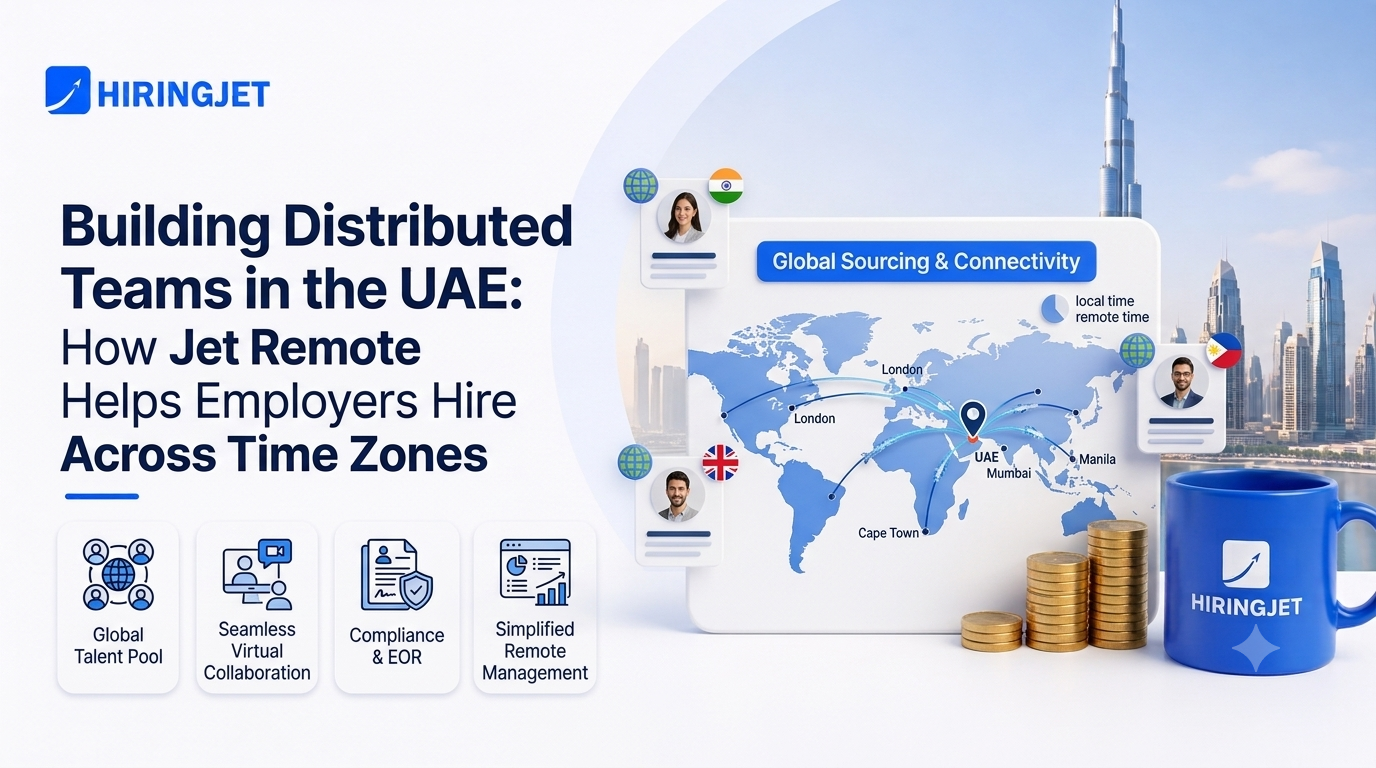
The employers getting this right are not simply “allowing remote work” as a perk; they are deliberately building remote-ready teams using structured tools, and HiringJet's Jet Remote feature is built specifically for that shift. This guide looks at why distributed hiring is growing in the UAE, why Dubai's time zone is a genuine strategic advantage rather than a nice-to-have, and how Jet Remote replaces ad hoc remote hiring with a structured, filterable process.
Why UAE Employers Are Building Distributed and Remote Teams in 2026
Employee appetite for flexible work arrangements remains significant in the UAE, even as many companies have settled into hybrid-first norms rather than fully remote ones. A Parisima Talent survey (a Dulsco Group talent business, published December 2024, based on 1,000 UAE-based respondents) found that 39% of UAE employees favour a hybrid work model, 44% prefer primarily office-based work with limited remote flexibility, and 16% prefer fully remote arrangements. Read together, that means well over half of the UAE workforce wants at least some remote flexibility built into their role, which has direct implications for employers competing for talent, particularly in tech, customer support, content, and back-office functions where physical presence adds little operational value.
At the same time, UAE employers are not just hiring remote staff who happen to live locally. Distributed hiring — building teams that combine UAE-based staff with remote employees in other GCC countries, South Asia, and beyond — has become a genuine growth lever for companies that want to extend coverage hours or access specialist skills without opening a second office.
The UAE's Time Zone Advantage for Distributed Hiring
One factor that rarely gets enough attention in the remote-hiring conversation is geography. Dubai sits on GST (UTC+4), which creates a meaningfully different overlap profile than most other outsourcing or remote-hub locations.
Overlapping With Europe
Dubai's GST offers a 2-4 hour overlap with major European business hours (London, Berlin, Paris), depending on the season. A UAE-based or UAE-managed team starting the workday at 8:00am GST is already several hours into its day by the time European offices open, meaning reports, escalations, and handoffs can be ready before a European counterpart's morning meeting — a pattern sometimes called the “productivity buffer” model. That is a meaningfully shorter, easier-to-manage gap than the 7-8 hour difference typical of Southeast Asian outsourcing hubs relative to Europe.
Overlapping With Asia-Pacific
In the other direction, the UAE's time zone provides workable overlap with South and Southeast Asian markets during the UAE morning, making it a practical base for teams that need to coordinate across both Europe and Asia in the same working day — a genuine structural advantage over both purely European and purely Asian hiring hubs.
The Hidden Cost of Ad Hoc Remote Hiring
Many UAE employers already have some remote or hybrid staff, but manage them the way they always managed office staff: a CV, a video interview, and a hope that the arrangement works out. The problems this creates tend to surface only after the hire:
- No structured way to verify a candidate's actual remote-work readiness (reliable internet, power backup, a workable home setup) before an offer is made.
- No visibility into time-zone overlap until the new hire's first missed morning stand-up.
- No easy way to search specifically for candidates who have already worked remotely successfully, versus candidates who are simply applying to any listing.
- Difficulty building a genuine talent pool of remote-ready candidates for future roles, because remote hiring has been handled as a series of one-off exceptions rather than a repeatable process.
How Jet Remote Solves This for Employers
Structured Remote-Readiness Profiles
Jet Remote gives job seekers a dedicated remote-work-readiness profile covering location and working-time preferences, work availability, remote work setup (internet reliability, power backup, dedicated workspace), and identity verification. Instead of discovering these details in week three, employers see them before they ever schedule an interview.
Filtering by Time-Zone Overlap, Setup, and Experience
Employers using Jet Remote can filter the candidate pool specifically by time-zone overlap with their business hours, internet and power-backup reliability, and prior remote-work experience — turning “does this person actually work well from home” from a gut-feel guess into a searchable, filterable criterion.
Bulk Email and Talent Pools for Remote Candidates
Because distributed hiring is rarely a one-time need, Jet Remote lets employers build and maintain folders of remote-ready candidates and use bulk email to reach an entire remote talent pool at once — useful for companies scaling a distributed support or engineering function over several hiring rounds rather than a single role.
A Practical Use Case: Hiring a Distributed Customer Support or Tech Team
Consider a UAE-based e-commerce or SaaS company that needs to extend customer support coverage into European evening hours, or that wants to hire developers who can collaborate with a Dubai-based product team without relocating. Rather than posting a generic “remote job UAE” listing and hoping the right candidates apply, an employer using Jet Remote can:
- Post the role with clear time-zone and availability requirements built into the listing.
- Use Jet Remote's filters to shortlist candidates who have already declared compatible working hours and verified remote-work setups.
- Review AI-recommended matches ranked against the role's specific remote requirements, rather than manually screening every applicant's CV for remote-work signals.
- Build a standing “distributed support” or “distributed engineering” talent folder for the next hiring round, instead of starting from zero each time.
The result is a distributed hiring process that looks and feels as structured as in-office hiring, rather than a workaround bolted onto a system built for single-city teams.
What This Means for Cost, Coverage, and Retention
Distributed hiring is not simply a cost play, but it does change the economics of coverage. Extending customer support into European evening hours by hiring a second UAE-based shift is expensive relative to hiring one remote specialist already working compatible hours from a lower-cost location within reasonable time-zone reach. It also changes retention dynamics: employees who explicitly chose a hybrid or remote arrangement, rather than having one imposed on them after the fact, tend to view the flexibility as part of their compensation package, not a bonus that can be quietly withdrawn. Building that expectation properly from the hiring stage — through a structured remote-readiness profile rather than an informal “let's see how it goes” conversation — reduces the number of remote arrangements that quietly fail six months in because neither side clarified expectations around availability, communication, and equipment upfront.
For employers specifically weighing distributed hiring against opening a second physical office or engaging a staffing agency for overseas coverage, Jet Remote sits in a useful middle ground: it keeps the hiring and management relationship direct (the employee is hired by your company, not an intermediary), while still giving you the structured screening data you would otherwise only get through a specialist remote-staffing vendor.
Getting Started: Using Jet Remote as a UAE Employer
Jet Remote is available to HiringJet employers on qualifying subscription plans, alongside the platform's other Jet features (Jet Screen for AI-ranked candidate search, Jet Walk-In for high-volume walk-in hiring events, and Jet Boost for job-seeker profile visibility). If your company already has a free HiringJet employer account, upgrading unlocks remote candidate search and the filtering capability described above. If you're new to the platform, you can post a job on HiringJet today and start building a distributed, remote-ready talent pipeline rather than treating remote hires as one-off exceptions.
Frequently Asked Questions
What is Jet Remote and who is it for?
Jet Remote is a HiringJet feature that gives job seekers a structured remote-work-readiness profile and gives employers the ability to search and filter that pool by time-zone overlap, remote setup, and remote-work experience — built for UAE employers hiring distributed or remote-first teams.
Why is Dubai's time zone considered an advantage for distributed hiring?
Dubai's GST (UTC+4) time zone overlaps with European business hours by roughly 2-4 hours and provides workable overlap with South and Southeast Asian markets in the same working day, giving UAE-based or UAE-managed teams a shorter, easier-to-manage handoff window than teams based purely in Asia or purely in Europe.
Do most UAE employees actually want remote work?
A Parisima Talent survey (Dulsco Group, December 2024, 1,000 UAE respondents) found 39% of UAE employees favour hybrid work and 16% favour fully remote work, meaning more than half want at least some remote flexibility — a meaningful factor for employers competing for talent in remote-friendly functions.
How is Jet Remote different from just posting a “remote job” listing?
A standard listing tells you who applied; Jet Remote tells you who applied and has a verified, structured remote-readiness profile covering time-zone overlap, internet/power reliability, and prior remote-work experience, so screening happens before the interview stage rather than after a bad hire.
Can recruitment agencies use Jet Remote?
Jet Remote and the other Jet features are currently available to HiringJet employer accounts; recruitment agencies on HiringJet manage jobs and candidates through the agency module, which mirrors core employer tools but does not currently include the Jet feature suite.
How do I start hiring remote or distributed teams through HiringJet?
Create or log in to your HiringJet employer account, post the role with clear remote/time-zone requirements, and upgrade your plan to access Jet Remote's candidate search and filtering tools, or contact HiringJet to learn which subscription tier fits your hiring volume.