
How to Hire Pharmaceutical Professionals in Saudi Arabia: A 2026 Guide for Employers
Saudi Arabia is the largest pharmaceutical market in the Middle East and North Africa, and it is in the middle of a structural shift that makes hiring pharmaceutical talent there meaningfully harder than it was even three or four years ago.
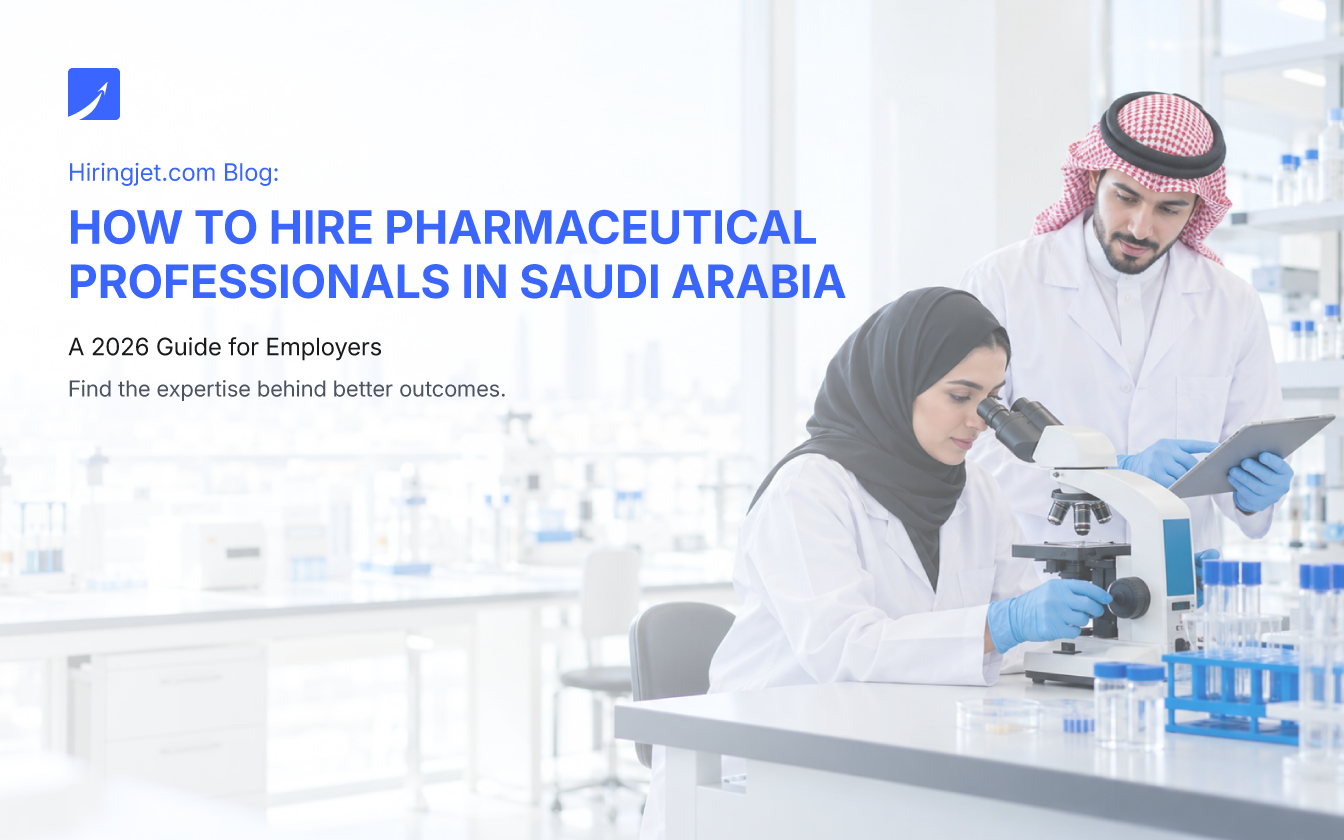
Regulatory oversight has tightened, local manufacturing is expanding under Vision 2030, and a wave of Saudization requirements has reshaped who companies can legally put into sales, regulatory, and operational roles. For employers used to sourcing pharma talent the old way — a recruiter's personal network, a handful of job-board postings, a slow manual CV review — that approach is increasingly too slow and too narrow for a market this regulated and this competitive for skilled national talent. This guide covers what's actually driving pharmaceutical hiring demand in Saudi Arabia in 2026, the compliance context employers need to plan around, realistic salary benchmarks for the roles in highest demand, and how a platform like HiringJet changes the sourcing and screening side of the process.
Why Pharmaceutical Hiring Demand in Saudi Arabia Is Rising
The scale of the opportunity is real. Saudi Arabia's pharmaceutical market was valued at between US$14 billion and US$16 billion in 2024, according to Oliver Wyman analysis, making it by far the largest pharma market in the region. The generics segment alone grew from roughly US$8–9 billion in 2021 to US$14–16 billion in 2024, now representing close to 40% of total market share and growing faster than originator (branded) medicines.
Demographic trends are compounding this: Saudi Arabia's population grew from about 16 million in 1990 to roughly 37 million in 2025, life expectancy rose from 69 to 79 years over the same period, 19% of adults have at least one chronic condition, and the share of the population over 65 is projected to rise from 3.6% in 2025 to between 20% and 25% by 2050 — a demand curve that keeps pushing upward for years to come.
Local manufacturing is growing in parallel. Locally produced drugs rose from 26.3% of total drug consumption in 2019 to 30.5% in 2024, and localization is becoming an increasingly explicit factor in public-sector procurement decisions, under the Health Sector Transformation Program's push to expand access to key health services to 88% of the population. For employers, this translates directly into hiring demand for production, quality assurance, and regulatory roles that support locally manufactured, SFDA-compliant supply.
What's Actually Driving the Hiring Demand: GMP, Regulatory Affairs, and Quality
The clearest signal in the current Saudi pharma hiring market is a sharp shift toward compliance-adjacent roles. Industry analysis from Pharmuni indicates that over 45% of pharmaceutical companies in Saudi Arabia increased their GMP (Good Manufacturing Practice) hiring demand over the past year, driven by stricter Saudi Food and Drug Authority (SFDA) oversight and expanding local manufacturing capacity. Regulatory affairs and quality-focused roles now make up close to 40% of new pharma hiring demand across the region. Employers who are still sourcing primarily for commercial/sales headcount, without building out regulatory affairs, quality assurance, and GMP compliance capacity alongside it, are increasingly out of step with where the market's real hiring pressure sits.
Roles in Highest Demand
Regulatory Affairs Specialists, Validation Engineers, industrial and clinical Pharmacists, Production Supervisors, QC Analysts, Quality Assurance Specialists, and Medical Representatives are the roles showing the clearest hiring activity right now, per Pharmuni's 2026 Saudi pharma jobs analysis. Named employers actively hiring in this space include the SFDA itself (regulatory affairs and compliance), SPIMACO (manufacturing and GMP), Tabuk Pharmaceuticals (quality and supply chain), and Jamjoom Pharma (commercial and production roles) — a useful signal of where Saudi Arabia's pharma employment is actually concentrated by function.
Salary Benchmarks for Pharmaceutical Roles in Saudi Arabia (2026)
The following monthly salary ranges, in Saudi Riyals, are drawn from Pharmuni's 2026 Saudi pharma jobs analysis. These are reported ranges rather than guaranteed figures — actual offers vary by company size, location, and candidate experience — but they give employers a realistic starting benchmark for budgeting a pharma hiring plan:
- Regulatory Affairs Specialist: SAR 16,000–25,000/month
- Validation Engineer: SAR 15,000–25,000/month
- Pharmacist (Industrial/Clinical): SAR 16,000–22,000/month
- Production Supervisor: SAR 12,000–20,000/month
- QC Analyst: SAR 10,000–14,000/month
- Quality Assurance (QA) Specialist: SAR 5,000–15,000/month
- Medical Representative: SAR 8,000–14,000/month
Note the unusually wide range on QA Specialist roles (SAR 5,000–15,000) relative to other compliance-adjacent roles — this likely reflects a split between entry-level QA hires and more senior quality leads being tracked under the same job title, so employers should scope the seniority level clearly in the job description rather than relying on title alone.
Saudization and Nitaqat: What Employers Need to Plan Around
Workforce nationalization has a particularly long history in Saudi pharma specifically. Pharmaceutical sales forces were an early, high-profile target of Saudization: companies were required to reach 40% Saudi sales representatives by the end of 2019 and 80% by 2020, working toward a target of having all sales representatives be Saudi nationals. Large multinationals adjusted significantly — one major pharma employer's Saudi share of nationalized sales roles rose from around 15% in 2019 to roughly 50% in subsequent years, while another ran a dedicated national recruitment campaign targeting around 140 additional Saudi hires.
The broader Nitaqat program itself has continued to evolve: the Ministry of Human Resources and Social Development issued a Developed Nitaqat Programme Procedural Guide for 2026, with entry thresholds that now vary significantly by sector and are set on a forward-looking basis for 2026 through 2028, calculated on a logarithmic formula (rather than flat percentage steps) so that nationalization targets rise gradually with a company's headcount.
Saudization compliance is assessed at the entity level, across all branches performing the same economic activity, and falling into a low compliance band carries real operational consequences — including restrictions on new visas and profession changes. Given pharma's history as an early, intensively nationalized sector, employers hiring pharmaceutical talent in Saudi Arabia in 2026 should treat Saudization planning as a core part of workforce planning from the outset, not an afterthought once a hiring plan is already built, and should confirm current sector-specific thresholds directly against the MHRSD's Nitaqat calculator rather than relying on historical figures.
How HiringJet Helps Employers Hire Pharmaceutical Talent in Saudi Arabia
Hiring compliance-heavy pharma roles at volume — regulatory affairs, QA, GMP, production — is exactly the kind of structured, criteria-driven search Jet Screen's AI-ranked candidate search is built for. Instead of manually reading through hundreds of CVs, employers can search and filter candidates using 30+ filters plus Boolean search, and Jet Screen computes a 0–100% Match Percentile per candidate against the role, weighted across skills (30%), experience (20%), location (15%), education (10%), salary expectations (10%), visa/work authorization (5%), profile freshness (5%), and notice period (5%) — a particularly useful structure for pharma roles where specific regulatory qualifications and work-authorization status both matter heavily.
For employers that need to fill several roles quickly — for example, standing up a new QA or production shift — Jet Walk-In lets you publish and manage a walk-in hiring event (minimum 10 slots, up to one calendar week, with up to 20 AI-recommended candidates matched automatically) rather than running a slow one-by-one interview pipeline. Every job post also goes through an AI-driven approval workflow before going live, and candidate and employer documents are independently verified by HiringJet's Backoffice team, which matters in a sector where credential verification (pharmacy licensure, GMP certification, SFDA-relevant qualifications) is not optional.
Building a Practical Pharma Hiring Plan for the Saudi Market
Start by separating your hiring plan into its two realistic tracks: commercial/sales roles, which sit under the most mature and longest-standing Saudization requirements, and regulatory/quality/GMP roles, which are where the real volume of new hiring demand currently sits. For commercial roles, build Saudi-national pipeline development into your workforce plan well before a role opens, since the qualified, Saudi-national sales-rep pool is competed for aggressively across multinational and local manufacturers alike.
For regulatory, quality, and GMP roles, prioritize candidates who can demonstrate specific SFDA-relevant experience or formal quality-risk-management and data-integrity training, since these are the qualifications the Pharmuni data flags as the clearest current differentiator between candidates. Budget salary offers against the ranges above but scope seniority explicitly in the job description, especially for QA roles where the title alone doesn't reliably signal seniority. And build in time for document verification — trade license, SFDA-relevant credentials, and (for agency-sourced candidates) TRN-equivalent checks — as a planned step in your hiring timeline rather than a bottleneck you discover midway through.
Where to Go From Here
Explore HiringJet's employer platform to see the full toolset available for structured, compliance-aware hiring, or go straight to post pharmaceutical roles directly to Saudi Arabia's largest pool of active job seekers. If your pharma hiring need is concentrated around Riyadh's concentration of pharmaceutical manufacturing and regulatory talent, filtering candidates by city alongside Jet Screen's match-percentile ranking will narrow your shortlist fast. Agencies and in-house teams managing hiring on behalf of multiple pharma manufacturers can also work through a specialized recruitment agency partner, browse HiringJet's verified employer directory to see how other verified employers present themselves, or check HiringJet's employer FAQs for details on document verification and subscription tiers before you start posting.
Frequently Asked Questions
How big is the pharmaceutical hiring opportunity in Saudi Arabia right now?
Saudi Arabia's pharmaceutical market was valued at between US$14 billion and US$16 billion in 2024 (Oliver Wyman), the largest in the MENA region, with the generics segment alone growing from roughly US$8–9 billion in 2021 to US$14–16 billion in 2024. Demographic trends — population growth, rising life expectancy, and an aging population — point to continued demand growth over the next decade.
What pharmaceutical roles are employers hiring for most right now?
Regulatory Affairs Specialists, Validation Engineers, industrial/clinical Pharmacists, Production Supervisors, QC Analysts, QA Specialists, and Medical Representatives show the clearest hiring activity, according to Pharmuni's 2026 analysis — with regulatory, quality, and GMP compliance roles representing close to 40% of new hiring demand across the region.
What do Saudization/Nitaqat rules mean for hiring pharmaceutical sales staff?
Pharmaceutical sales forces were an early, high-profile target of Saudization, with companies historically required to work toward 40% Saudi sales reps by the end of 2019 and 80% by 2020. The broader Nitaqat program has since evolved into a 2026–2028 forward-looking, sector-specific threshold system calculated on a logarithmic formula rather than flat steps, assessed at the entity level across all branches. Employers should confirm current sector thresholds directly against the MHRSD's Nitaqat calculator before building a hiring plan.
What salary should we budget for pharmaceutical roles in Saudi Arabia?
Reported 2026 monthly ranges (Pharmuni) run from SAR 5,000–15,000 for QA Specialists, SAR 8,000–14,000 for Medical Representatives, SAR 10,000–14,000 for QC Analysts, SAR 12,000–20,000 for Production Supervisors, SAR 15,000–25,000 for Validation Engineers, SAR 16,000–22,000 for industrial/clinical Pharmacists, and SAR 16,000–25,000 for Regulatory Affairs Specialists. Scope seniority explicitly in the job description, since titles like QA Specialist span a particularly wide range.
How does HiringJet help employers screen pharmaceutical candidates faster?
Jet Screen lets employers search and filter candidates using 30+ filters and Boolean search, and ranks each candidate with a 0–100% Match Percentile weighted across skills, experience, location, education, salary expectations, visa/work authorization, profile freshness, and notice period — useful for compliance-heavy pharma roles where both qualifications and work-authorization status matter. Jet Walk-In additionally supports fast, structured hiring events for filling multiple roles (such as a new QA or production shift) at once.
Why is local manufacturing growth relevant to pharma hiring in Saudi Arabia?
Locally produced drugs rose from 26.3% of total drug consumption in 2019 to 30.5% in 2024, and localization is becoming more explicit in public-sector procurement decisions. This directly increases hiring demand for production, quality assurance, and regulatory roles that support SFDA-compliant, locally manufactured supply — on top of the broader GMP hiring increase reported industry-wide.