
How to Hire Employees in Saudi Arabia: A Complete Guide for Employers (2026)
Saudi Arabia is next on HiringJet's priority-market list after Dubai and the wider UAE — and for employers, it's a genuinely different hiring environment, not just a bigger version of the UAE market. Saudi national unemployment has fallen from 12.3% when Vision 2030 launched in 2017 to around 7.2% in Q4 2025, private-sector employment of Saudi nationals has grown from under 1.5 million in 2017 to roughly 2.2 million today, and women's labor-force participation now exceeds 35%. That growth has been driven in large part by an active, closely-enforced Saudization (Nitaqat) system that shapes almost every hiring decision an employer makes in the Kingdom.
For an employer used to hiring in the UAE, this means the fundamentals genuinely change: how many Saudi nationals you must employ (and at what minimum wage) is calculated automatically, tied to a live compliance band that governs whether you can bring in expat talent at all, renew Iqamas, or even bid on government tenders. Getting this wrong before you post a single job costs real time and money — blocked visas, stalled residency renewals, and MHRSD fines. This guide walks through what to check before you hire, what hiring actually costs once GOSI and levies are included, the legal steps to hire someone, and where HiringJet fits into the process.
Why Saudi Arabia Is a Priority Hiring Market Right Now
The scale of change in the Saudi labor market over the past several years is a large part of why it's a priority market for HiringJet's expansion. According to Vision 2030 tracking data, the unemployment rate among Saudi nationals has dropped from 12.3% at the program's 2017 launch to approximately 7.2% in the fourth quarter of 2025 — driven by Saudization policy, rising female workforce participation (now over 35%), and expansion in sectors like tourism, retail, and entertainment that barely existed in their current form a decade ago. Private-sector employment of Saudi nationals has grown alongside this, from fewer than 1.5 million in 2017 to roughly 2.2 million today, an increase of around 700,000 Saudi-held private-sector jobs in under a decade.
For employers, that combination — a rapidly professionalizing local talent pool plus continued demand for specialized expat skills in sectors like construction, engineering, and healthcare — means Saudi Arabia increasingly rewards employers who understand the compliance system well enough to hire quickly and confidently, rather than those who treat it as an afterthought once a candidate has already accepted an offer.
Understand Saudization (Nitaqat) Before You Post a Single Job
Nitaqat is Saudi Arabia's Saudization compliance system, and it classifies every company into one of five color-coded bands based on how well it meets its Saudi-national hiring quota: Platinum (the top tier, with the most flexibility on visa issuance and work-permit renewals), High Green, Medium Green, and Low Green (progressively less flexibility), and Red (non-compliant, facing severe restrictions). Your band isn't set once and forgotten — it's reassessed on an ongoing basis, and it directly determines whether you can bring in new expat hires at all.
Quotas are sector-specific rather than a single flat percentage across the economy, and the formulas behind them have been getting stricter. Two recent examples illustrate the trend: engineering firms with five or more engineers must now maintain at least 30% Saudi nationals among their engineering staff (effective from 27 July 2025), while accounting firms with five or more accountants face a phased requirement starting at 40% Saudi nationals and rising to 70% over five years (effective from 27 October 2025). Employers hiring into regulated professions should check the current sector-specific quota rather than assuming a generic figure applies.
There's also a minimum-wage floor that determines whether a Saudi hire even counts toward your quota at all: as of the 2026 cycle, a Saudi national must earn at least SAR 4,000 a month (up from SAR 3,000) for that role to count, with higher profession-specific thresholds — SAR 5,500 a month for marketing roles, SAR 8,000 for engineering, and SAR 9,000 for dentistry. Hiring a Saudi national below the applicable threshold does not improve your Nitaqat position, which is a common and costly mistake among employers who assume any Saudi hire helps their band.
One more compliance detail that changed recently matters more than it might sound: as of 15 April 2026, only Saudi employees whose employment contracts are formally documented through the Qiwa platform are counted in Saudization calculations at all. In practice, that means registering every employment contract on Qiwa isn't optional administrative paperwork — it is the mechanism that determines your compliance band in the first place.
What Happens If You're Classified Red or Low Green
Falling into the Red or Low Green bands triggers a cascade of real operational restrictions: your ability to hire new foreign workers is restricted or blocked outright, Iqama (residency permit) renewals for your existing expat staff are delayed, your visa quotas can be suspended, you become ineligible to bid on government contracts through the Etimad platform, the Ministry of Human Resources and Social Development (MHRSD) can levy fines directly, and in more serious cases your access to the Qiwa, Mudad, and Muqeem government systems can be suspended entirely — which effectively halts your ability to manage payroll and residency for your whole workforce, not just new hires.
The Real Cost of Hiring in Saudi Arabia: GOSI, Iqama, and Levies
Base salary is only part of what hiring in Saudi Arabia actually costs an employer, and the two biggest additional line items — GOSI social insurance and Iqama-related fees — differ substantially depending on whether you're hiring a Saudi national or an expat.
For Saudi nationals, GOSI contribution rates currently run on two parallel tracks depending on when the employee first registered with GOSI. Employees registered before 3 July 2024 remain on the legacy structure: employer 11.75% plus employee 9.75%, for a combined 21.5%. Employees registered after that date are on a newer structure that is stepping up through 2026: employer 12.25% plus employee 10.25% (22.5% combined) from January to June 2026, rising to employer 12.75% plus employee 10.75% (23.5% combined) from July to December 2026. Contributions are capped at a monthly wage base of SAR 45,000 (basic salary plus housing allowance). For expat employees, the calculation is far simpler: the employer alone pays a 2% occupational-hazards contribution, with no GOSI deduction from the employee's side at all.
On top of GOSI, expat hires carry Iqama and visa-related costs that employers need to budget into their real cost-per-hire: an annual Iqama renewal fee of roughly SAR 650 for a standard company employee (SAR 600 for domestic workers), a work-permit levy (sometimes called Maktab Amal or the Muqeem fee) of up to SAR 800 a month for companies where expatriates outnumber Saudi nationals, which can be reduced toward roughly SAR 700 a month for employers who meet their Saudization requirements, a dependent sponsorship fee of about SAR 400 a month per family member (roughly SAR 4,800 a year), an additional SAR 500 a year for renewing a dependent's own Iqama once they're over 18, and a smaller digital processing fee of about SAR 51.75 per renewal through the Absher Business platform.
None of this is exotic — but it is easy for an employer used to UAE hiring costs to under-budget, since the UAE has no direct equivalent to GOSI's employee-side percentage or the sliding work-permit levy. Modeling these costs before extending an offer, rather than after, is one of the simplest ways to avoid an unpleasant surprise on your first Saudi payroll run.
Step-by-Step: How to Legally Hire in Saudi Arabia
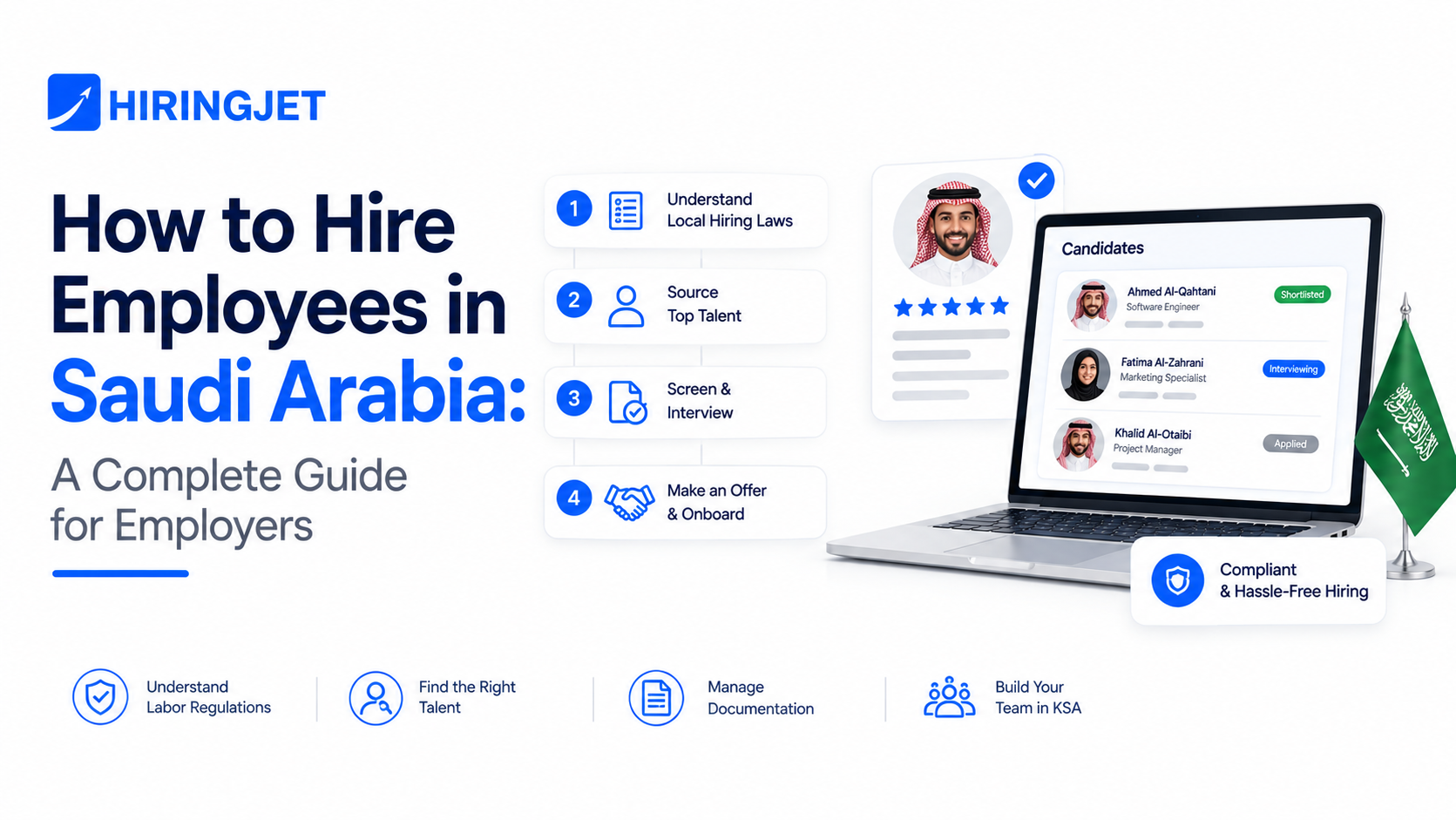
The legal hiring process in Saudi Arabia follows a fairly consistent sequence, whether you're a UAE-based employer expanding into the Kingdom for the first time or a locally established company hiring for a new role.
- Register your company on Qiwa and confirm your current Nitaqat band before you plan any hire — this determines whether an expat hire is even an option right now.
- Register for GOSI and set up payroll through the Wage Protection System (WPS), which Saudi authorities use to verify salaries are actually paid as contracted.
- Decide whether the role should go to a Saudi national or an expat hire, factoring in both your current Nitaqat band and whether the role's salary clears the minimum-wage-for-quota threshold that applies to that profession.
- Write the job description and screen candidates — an AI job-description generator and an AI-ranked candidate search tool, like HiringJet's Jet Screen, can meaningfully cut the time this step takes, particularly for high-volume roles.
- Extend an offer and issue an employment contract, and make sure that contract is formally documented through Qiwa — since 15 April 2026, this is what makes a Saudi hire count toward your Saudization calculation at all.
- For expat hires specifically, sponsor the work visa and Iqama, and budget for the levy and dependent fees outlined above from the outset rather than discovering them mid-process.
- Onboard the new hire through your applicant tracking system and keep your Qiwa and GOSI records current on an ongoing basis — your Nitaqat band is reassessed periodically, not fixed at the moment you make a hire.
Where to Find Qualified Candidates in Saudi Arabia
HiringJet already supports employer and job-seeker activity across Saudi Arabia's key hiring markets, including Riyadh, Dammam, and Khobar, alongside the national hub. Employers can use AI-driven candidate-job matching to surface relevant applicants faster than manual CV screening, and candidate and employer verification badges (built on document checks like trade license and tax registration) help build trust in a market where recruitment fraud is a real, active concern for both sides. Recruitment agencies operating on behalf of Saudi-based clients can also manage candidate sourcing and job postings through HiringJet's agency tools, which mirror the employer feature set — though the platform's dedicated Jet features are reserved for direct employer accounts.
How HiringJet Simplifies Hiring in Saudi Arabia for Employers
Employers testing the Saudi market can start with HiringJet's free plan, which allows posting up to three jobs for three months at no cost (CV search and downloads aren't included on the free tier, but job posting and applications are). From there, HiringJet's AI job-description generator helps produce a compliant, well-structured posting in minutes rather than hours, and Jet Screen ranks every applicant against the role with a transparent 0–100% match percentile — weighted across skills (30%), experience (20%), location (15%), education (10%), salary expectations (10%), visa or work-authorization status (5%), profile freshness (5%), and notice period (5%) — so you're not manually reading through every CV to find the candidates worth a first call.
Once you're hiring at volume, the built-in Applicant Tracking System keeps every candidate's status current from application through to hire, and the employer dashboard surfaces analytics like applications per job, your shortlist-to-hire conversion funnel, and average time-to-shortlist — useful benchmarks as you refine your Saudi hiring process over your first few roles.
Common Hiring Mistakes to Avoid in the Saudi Market
- Posting a role — especially one requiring an expat hire — before checking your company's current Nitaqat band, only to discover the visa can't be issued.
- Budgeting only base salary and overlooking GOSI, the work-permit levy, and dependent fees, which can add a meaningful percentage on top of gross pay.
- Treating Qiwa contract registration as routine paperwork rather than the mechanism that determines whether a Saudi hire actually counts toward your Saudization band.
- Underestimating how long Iqama and work-visa processing takes for an expat hire, and setting a start date that assumes UAE-speed onboarding.
- Treating Saudization as a one-time hiring decision rather than an ongoing ratio that has to be maintained and can be reassessed against you later.
Frequently Asked Questions
What is Saudization (Nitaqat) and why does it matter for hiring in Saudi Arabia?
Nitaqat is Saudi Arabia's Saudization system, which classifies every company into a compliance band (Platinum, High Green, Medium Green, Low Green, or Red) based on how well it meets sector-specific Saudi-national hiring quotas. Your band directly determines whether you can hire new expat workers, renew Iqamas, or bid on government tenders, so it needs to be checked before — not after — you plan a hire.
How much does it cost an employer to hire a foreign worker in Saudi Arabia?
Beyond base salary, employers should budget for a 2% employer-paid GOSI occupational-hazards contribution, an annual Iqama renewal fee of around SAR 650, a work-permit levy of up to SAR 800 a month (potentially reduced to around SAR 700 for Saudization-compliant employers), and roughly SAR 400 a month per sponsored dependent.
What GOSI contribution rate applies to Saudi employees in 2026?
It depends on when the employee first registered with GOSI. Those registered before 3 July 2024 remain on the legacy 11.75% employer plus 9.75% employee structure (21.5% combined). Those registered after that date are on a newer structure rising through 2026: 12.25% employer plus 10.25% employee (22.5%) from January to June, increasing to 12.75% employer plus 10.75% employee (23.5%) from July to December.
What happens if my company falls into the Red or Low Green Nitaqat band?
You face restrictions on hiring new foreign workers, delays in Iqama renewals for existing staff, suspension of visa quotas, exclusion from government tenders via the Etimad platform, fines from the Ministry of Human Resources and Social Development, and potential suspension of access to the Qiwa, Mudad, and Muqeem government systems.
Can international recruitment agencies or platforms help me hire in Saudi Arabia?
Yes. Recruitment agencies can manage sourcing and job postings on behalf of Saudi-based employer clients through platforms like HiringJet, and HiringJet's own employer tools already support job posting, candidate search, and AI-ranked screening across Saudi Arabia's key markets, including Riyadh, Dammam, and Khobar.
How does HiringJet help employers hire in Saudi Arabia?
HiringJet lets employers post up to three jobs free for three months, generate job descriptions with AI, and rank every applicant with Jet Screen's 0–100% match percentile based on skills, experience, location, education, salary fit, work authorization, profile freshness, and notice period — plus an Applicant Tracking System and dashboard analytics to manage the process at scale.